PDF · English
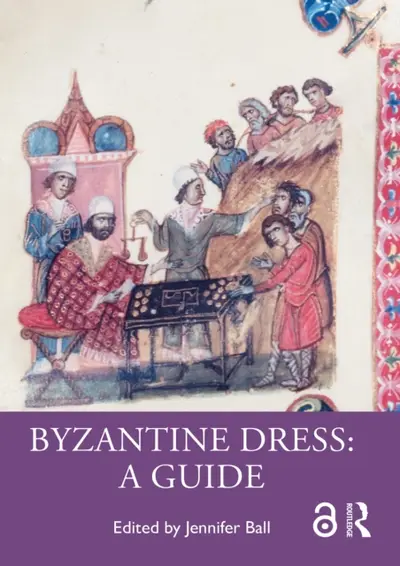
Byzantine Dress: A Guide
Price and availability
$50.99
Available in: Andorra, Austria, Australia, Belgium, Bulgaria, Canada, Switzerland, Cyprus, Czechia, Germany, Denmark, Estonia, Spain, Finland, France, United Kingdom, Guernsey, Greece, Croatia, Hungary, Ireland, Isle of Man, Iceland, Italy, Jersey, Japan, Liechtenstein, Lithuania, Luxembourg, Latvia, Monaco, Malta, Netherlands, Norway, Poland, Portugal, Romania, Sweden, Slovenia, Slovakia, San Marino, United States, Vatican City, South Africa
Stores: US, UK, Canada, EU, Australia.
Sign in to buyThe price is re-checked by the server before payment.
For personal use under the eBook licence.
- Format
- DRM
- Not stated by the publisher
- Language
- English
- Publisher
- Taylor and Francis Group
- Published
- 17 December 2024
- ISBN
- 9781040148570
- Subjects
- Byzantine Empire, History, Ancient history: to c 500 CE, Classical history / classical civilisation, Medieval history, Social & cultural history, Archaeological theory, Fashion & society, Byzantine Empire, Cultural studies: dress and society, History and Archaeology, Ancient history, Social and cultural history, Archaeological theory
About this book
This book offers approaches to the study of Byzantine dress of elites and non-elites, in sacred and secular modes, from the beginning of the Empire in the fourth century until the fifteenth century. Byzantine dress is considered from within and outside of the Empire and examines both artifactual remains as well as emphasizing studies that elucidate Byzantine dress when few or no artifacts exist.Byzantine Dress: A Guide tackles current conceptual frameworks in the first three chapters and considers identity and sartorial signaling among Byzantines as well as foreigners in images as well as actual items of dress. A second section addresses material considerations, reflecting on construction and its effect on value. The interpretation of archaeological material is analyzed, along with reconstruction and context. Dress as part of ritualsa "e;at court, church, and in various ceremoniesa "e;is the focus of the third section. The final two chapters bring Byzantine dress into conversation with dress studies more broadly. A discursive chapter argues for a fashion system within the Byzantine Empire, which has been largely seen as pre-dating the notion of fashion. The final chapter concerns the display, interpretation, and conservation of fragmentary material in a museum context.This book aims toward a general audience new to the subject of Byzantine dress. Specialists in Byzantine studies and dress studies more generally will find the attention to current scholarship and archaeological interpretation invaluable for research, and the book will also appeal to an audience new to the subject of Byzantine dress.
Bibliographic data © Gardners Books Ltd.