PDF · English
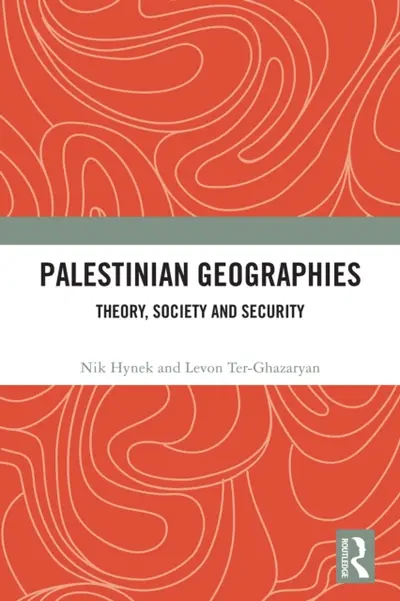
Palestinian Geographies
Theory, Society and Security
Price and availability
$64.99
Available in: Andorra, Austria, Australia, Belgium, Bulgaria, Canada, Switzerland, Cyprus, Czechia, Germany, Denmark, Estonia, Spain, Finland, France, United Kingdom, Guernsey, Greece, Croatia, Hungary, Ireland, Isle of Man, Iceland, Italy, Jersey, Japan, Liechtenstein, Lithuania, Luxembourg, Latvia, Monaco, Malta, Netherlands, Norway, Poland, Portugal, Romania, Sweden, Slovenia, Slovakia, San Marino, United States, Vatican City, South Africa
Stores: US, UK, Canada, EU, Australia.
Sign in to buyThe price is re-checked by the server before payment.
For personal use under the eBook licence.
- Format
- DRM
- Not stated by the publisher
- Language
- English
- Publisher
- Taylor & Francis
- Published
- 17 August 2026
- ISBN
- 9781040826898
- Subjects
- Israel, Palestine, Middle Eastern history, Politics & government, Warfare & defence, Human geography, Palestine, Social and cultural anthropology, Geopolitics, Political geography
About this book
This book investigates how Palestinians engage in compensatory movements to negotiate political authority, collective identity, and everyday life by opening alternative routes and creating functional spaces.What sets this work apart is its innovative focus on the principle of compensation, which disrupts linear readings of functionality or dysfunction in Palestinian spaces. Rather than viewing Palestinian life through dominant frameworks of resistance, resilience, victimhood, or adaptation to Westphalian norms, this book reveals how refugee camps, humanitarian agencies, pro-Palestinian demonstrations, and underground networks emerge as spaces of co-existential agency where circulatory mobilities take place. By examining Gaza's heterotopias, tunnel economies, UNRWA's evolving role, and more-than-human dimensions of Palestinian spaces, the authors demonstrate how compensatory processes sustain Palestinian political, economic, and symbolic life despite what is seen as settler colonialism and oppression. Drawing on spatial analysis, security studies, organization theory, and insights from continental philosophy, this interdisciplinary approach illuminates how Palestinians transcend rigid binaries of functional/dysfunctional spaces and fixed power asymmetries, challenging scholars to see beyond dominant paradigms and recognize compensation as a driving force in forging new spatial possibilities.This book will be of much interest to students, experts, and policy-makers engaged in Human and Political Geography, Postcolonial Studies, Middle East and Palestine, Peace and Conflict Studies, and Anthropology.
Bibliographic data © Gardners Books Ltd.