PDF · English
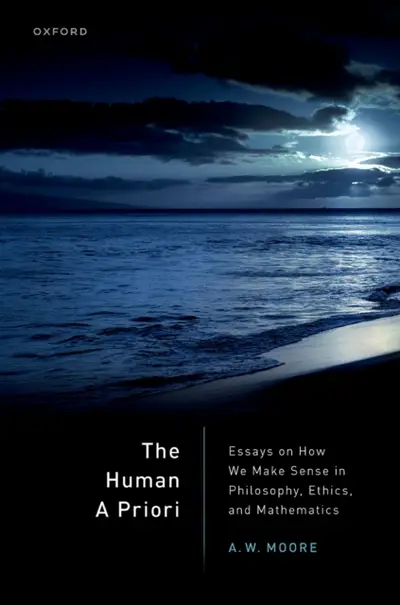
Human A Priori
Essays on How We Make Sense in Philosophy, Ethics, and Mathematics
Price and availability
$94.99
Available in: Andorra, Austria, Australia, Belgium, Bulgaria, Canada, Switzerland, Cyprus, Czechia, Germany, Denmark, Estonia, Spain, Finland, France, United Kingdom, Guernsey, Greece, Croatia, Hungary, Ireland, Isle of Man, Iceland, Italy, Jersey, Japan, Liechtenstein, Lithuania, Luxembourg, Latvia, Monaco, Malta, Netherlands, Norway, Poland, Portugal, Romania, Sweden, Slovenia, Slovakia, San Marino, United States, Vatican City, South Africa
Stores: US, UK, Canada, EU, Australia.
Sign in to buyThe price is re-checked by the server before payment.
For personal use under the eBook licence.
- Format
- DRM
- Not stated by the publisher
- Language
- English
- Publisher
- Oxford University Press
- Published
- 24 July 2023
- ISBN
- 9780192699206
- Subjects
- Philosophy, History of Western philosophy, Philosophy: epistemology & theory of knowledge, Philosophy: logic, Ethics & moral philosophy, History of ideas, Philosophical traditions and schools of thought, Philosophy: epistemology and theory of knowledge, Philosophy: logic, Ethics and moral philosophy
About this book
The Human A Priori is a collection of essays by A.W. Moore, one of them previously unpublished and the rest all revised. These essays are all concerned, more or less directly, with something ineliminably anthropocentric in our systematic pursuit of a priori sense-making. Part I deals with the nature, scope, and limits of a priori sense-making in general. Parts II, III, and IV deal with what are often thought to be the three great exemplars of the systematic pursuit of such sense-making: philosophy in the case of Part II, ethics in the case of Part III, and mathematics in the case of Part IV. Much of the attention throughout is devoted to the work of other philosophers: Kant and Wittgenstein feature prominently, and five of the essays take the form of reviews or critical notices of recent work in philosophy. But the interest in never purely exegetical. One of the lessons that emerges from the essays, either in opposition to the views of these other philosophers or by invocation of their views, is that we humans achieve nothing of real significance in philosophy, ethics, or mathematics except from a human point of view, and hence that all three of these pursuits can be said to betoken what may reasonably be called 'the human a priori'.
Bibliographic data © Gardners Books Ltd.