EPUB · English
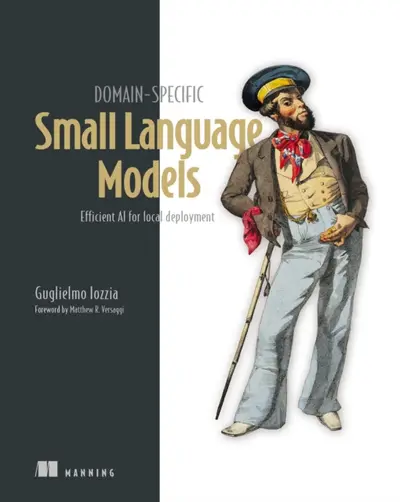
Domain-Specific Small Language Models
Efficient AI for local deployment
Price and availability
$59.99
Available in: Andorra, Austria, Australia, Belgium, Bulgaria, Canada, Switzerland, Cyprus, Czechia, Germany, Denmark, Estonia, Spain, Finland, France, United Kingdom, Guernsey, Greece, Croatia, Hungary, Ireland, Isle of Man, Iceland, Italy, Jersey, Japan, Liechtenstein, Lithuania, Luxembourg, Latvia, Monaco, Malta, Netherlands, Norway, Poland, Portugal, Romania, Sweden, Slovenia, Slovakia, San Marino, United States, Vatican City, South Africa
Stores: US, UK, Canada, EU, Australia.
Sign in to buyThe price is re-checked by the server before payment.
For personal use under the eBook licence.
- Format
- EPUB
- DRM
- Not stated by the publisher
- Language
- English
- Publisher
- Manning
- Published
- 9 June 2026
- ISBN
- 9781638357889
- Subjects
- Information theory, Information technology: general issues, Database programming, Web services, Computer architecture & logic design, Artificial intelligence, Human-computer interaction, Information architecture, Information theory, Digital and Information technology: general topics, Database programming, Web services, Computer architecture and logic design, Artificial intelligence (AI), Human–computer interaction, Information architecture
About this book
Get the eBook free when you register your print book at Manning.When you need a language model to respond accurately and quickly about a specific field of knowledge, the sprawling capacity of a LLM may hurt more than it helps. This book teaches you to build generative AI models optimized for specific fields.Perfect for cost- or hardware-constrained environments, Small Language Models (SLMs) train on domain specific data for high-quality results in specific tasks. In this book youll develop SLMs that can generate everything from Python code to protein structures and antibody sequencesall on commodity hardware.In Domain-Specific Small Language Models youll discover: Model sizing best practices Open source libraries, frameworks, utilities and runtimes Fine-tuning techniques for custom datasets Hugging Faces libraries for SLMs Running SLMs on commodity hardware Model optimization or quantizationForeword by Matthew R. Versaggi.About the technologySmall-footprint language models trained on custom data sets and hosted locally can perform as well as large generalist models in speed and accuracy, often at a fraction of the cost. Domain-Specific Small Language Models shows you how to build privacy-preserving and regulation-compliant SLMs for agentic systems, specialist applications, and deployment on the edge.About the bookThis is a practical book that shows you how to adapt pretrained open source models to your domain using transfer learning and parameter-efficient fine-tuning. Youll learn to minimize cost through optimization and quantization, develop secure APIs to serve your models, and deploy SLMs on commodity hardwareincluding small devices. The hands-on examples include integrating SLMs into RAG systems and agentic workflows.What's inside ONNX and other quantization methods Integrate SLMs into end-to-end applications Deploy SLMs on laptops, smartphones, and other devicesAbout the readerFor AI engineers familiar with Python.About the authorGuglielmo Iozzia is a Director of AI and Applied Mathematics at Merck & Co. and a Distinguished Member of the American Society for Artificial Intelligence. He specializes in AI biomedical applications.The technical editor on this book was Riccardo Mattivi.Table of ContentsPart 11 Small language modelsPart 22 Tuning for a specific domain3 End-to-end transformer fine-tuning4 Running inference5 Exploring ONNX6 Quantizing for your production environmentPart 37 Generating Python code8 Generating protein structuresPart 49 Advanced quantization techniques10 Profiling insights11 Deployment and serving12 Running on your laptop13 Creating end-to-end LLM applications14 Advanced components for LLM applications15 Test-time compute and small language models
Bibliographic data © Gardners Books Ltd.