PDF · English
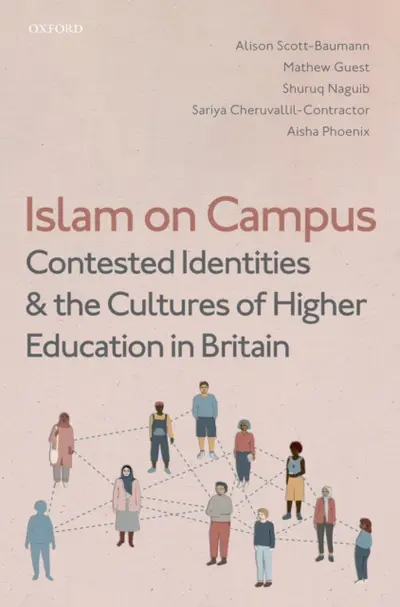
Islam on Campus
Contested Identities and the Cultures of Higher Education in Britain
Price and availability
$31.99
Available in: Andorra, Austria, Australia, Belgium, Bulgaria, Canada, Switzerland, Cyprus, Czechia, Germany, Denmark, Estonia, Spain, Finland, France, United Kingdom, Guernsey, Greece, Croatia, Hungary, Ireland, Isle of Man, Iceland, Italy, Jersey, Japan, Liechtenstein, Lithuania, Luxembourg, Latvia, Monaco, Malta, Netherlands, Norway, Poland, Portugal, Romania, Sweden, Slovenia, Slovakia, San Marino, United States, Vatican City, South Africa
Stores: US, UK, Canada, EU, Australia.
Sign in to buyThe price is re-checked by the server before payment.
For personal use under the eBook licence.
- Format
- DRM
- Not stated by the publisher
- Language
- English
- Publisher
- Oxford University Press
- Published
- 16 October 2020
- ISBN
- 9780192585998
- Subjects
- Comparative religion, Religion & politics, Islamic life & practice, Gender studies, gender groups, Educational strategies & policy, Multicultural education, Gender studies, gender groups, Educational strategies and policy, Comparative religion, Religion and politics, Islamic life and practice
About this book
Islam on Campus explores how Islam is represented, perceived and lived within higher education in Britain. It is a book about the changing nature of university life, and the place of religion within it. Even while many universities maintain ambiguous or affirming orientations to religious institutions for reasons to do with history and ethos, much western scholarship has presumed higher education to be a strongly secularizing force. This framing has resulted in religion often being marginalized or ignored as a cultural irrelevance by the university sector. However, recent times have seen higher education increasingly drawn into political discourses that problematize religionin general, and Islam in particular, as an object of risk. Using the largest data set yet collected in the UK, this book explores university life and the ways in which ideas about Islam and Muslim identities are produced, experienced, perceived, appropriated, and objectified. It asks what role universities and Muslim higher education institutions play in the production, reinforcement, and contestation of emerging narratives about religious difference. This is a culturally nuanced treatment of universities as sites of knowledge production, and contexts for the negotiation of perspectives on culture and religion among an emerging generation. It demonstrates the urgent need to release Islam from its official role as the othered, the feared. When universities achieve this we will be able to help students of all affiliations and of none to be citizens of the campus in preparation for being citizens of the world.
Bibliographic data © Gardners Books Ltd.