PDF · English
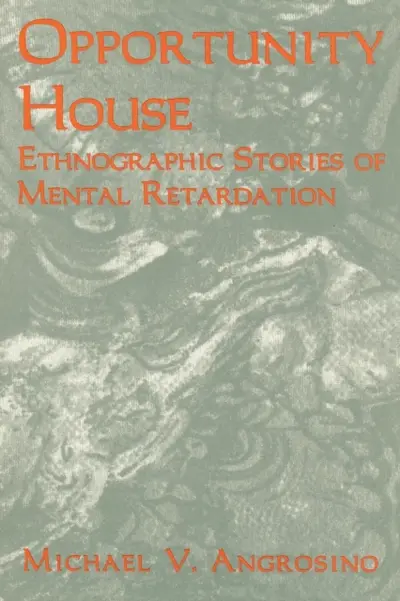
Opportunity House
Ethnographic Stories of Mental Retardation
Price and availability
Price unavailable
Available in: Andorra, Austria, Australia, Belgium, Bulgaria, Canada, Switzerland, Cyprus, Czechia, Germany, Denmark, Estonia, Spain, Finland, France, United Kingdom, Guernsey, Greece, Croatia, Hungary, Ireland, Isle of Man, Iceland, Italy, Jersey, Japan, Liechtenstein, Lithuania, Luxembourg, Latvia, Monaco, Malta, Netherlands, Norway, Poland, Portugal, Romania, Sweden, Slovenia, Slovakia, San Marino, United States, Vatican City, South Africa
Stores: US, UK, Canada, EU, Australia.
This title cannot be bought in this store yet: its supplier terms, territorial rights or price are still being confirmed.
For personal use under the eBook licence.
- Format
- DRM
- Not stated by the publisher
- Language
- English
- Publisher
- Bloomsbury Publishing (USA)
- Published
- 2 December 1997
- Pages
- 232
- ISBN
- 9781461647614
- Subjects
- Disability: social aspects, Anthropology, Social welfare & social services, JBFM, Anthropology, Social welfare, social policy and social services
About this book
Calling on a decade of participant observation at a residence for mentally retarded adults, anthropologist Michael V. Angrosino's riveting and de-mystifying account offers an insider's picture of the lives of the inhabitants of Opportunity House. Using the narrative device of a dozen fictional short stories told in the voices of various community members as well as that of the researcher, Angrosino weaves a life-histories approach to ethnography together with an innovative culture concept to tackle the complexities of representing marginalized subgroups. As opposed to traditional clinical or statistical studies, which have insufficiently conveyed the subjective and experiential perspectives of retarded people themselves, Angrosino presents an intimate and complex picture of a highly functioning community with its cast of entrepreneurs, bullies, victims, and do-gooders. This wonderfully readable and captivating account is therefore an important resource for those interested in mental illness and disability, as well as a model for those experimenting with forms of ethnographic writing.
Bibliographic data © Gardners Books Ltd.