PDF · English
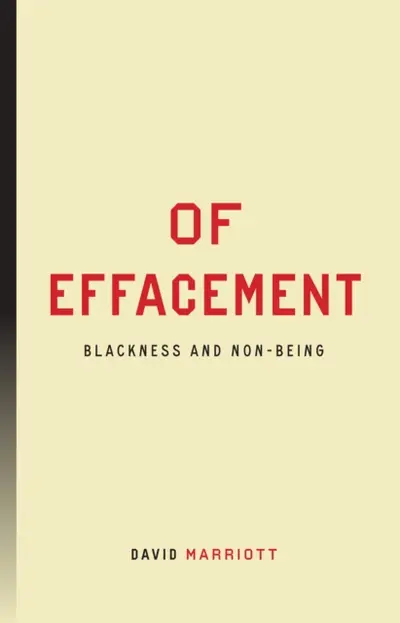
Of Effacement
Blackness and Non-Being
Price and availability
$32.99
Available in: Andorra, Austria, Australia, Belgium, Bulgaria, Canada, Switzerland, Cyprus, Czechia, Germany, Denmark, Estonia, Spain, Finland, France, United Kingdom, Guernsey, Greece, Croatia, Hungary, Ireland, Isle of Man, Iceland, Italy, Jersey, Japan, Liechtenstein, Lithuania, Luxembourg, Latvia, Monaco, Malta, Netherlands, Norway, Poland, Portugal, Romania, Sweden, Slovenia, Slovakia, San Marino, United States, Vatican City, South Africa
Stores: US, UK, Canada, EU, Australia.
Sign in to buyThe price is re-checked by the server before payment.
For personal use under the eBook licence.
- Format
- DRM
- Not stated by the publisher
- Language
- English
- Publisher
- Stanford University Press
- Published
- 28 November 2023
- ISBN
- 9781503637269
- Subjects
- Literary theory, Philosophy, Ethnic studies, Ethnic minorities & multicultural studies, Literary theory, JBSL, JBSL1, QD
About this book
In Of Effacement, David Marriott endeavors to demolish established opinion about what blackness is and reorient our understanding of what it is not in art, philosophy, autobiography, literary theory, political theory, and psychoanalysis. With the critical rigor and polemical bravura which he displayed in Whither Fanon? Marriott here considers the relationships between language, judgement and effacement, and shows how effacement has become the dominant force in anti-blackness. Both skeptically and emphatically, Marriott presents a series of radical philosophical engagements with Fanon's "e;is not"e; (n'est pas) and its "e;black"e; political truth. How does one speak let alone represent that which is without existence? Is blackness n'est pas because it has yet to be thought as blackness? And if so, when Fanon writes of blackness, that it is n'est pas (is not), where should one look to make sense of this n'est pas? Marriott anchors these questions by addressing the most fundamental perennial questions concerning the nature of freedom, resistance, mastery, life, and liberation, via a series of analyses of such key figures as Huey Newton, Nietzsche, Malcolm X, Edward Said, Georges Bataille, Stuart Hall, and Lacan. He thus develops the basis for a reading of blackness by recasting its effacement as an identity, while insisting on it as a fundamental question for philosophy.
Bibliographic data © Gardners Books Ltd.