PDF · English
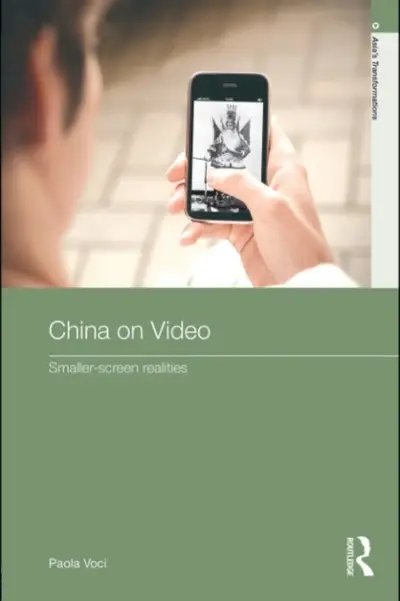
China on Video
Smaller-Screen Realities
Price and availability
$68.99
Available in: Andorra, Austria, Australia, Belgium, Bulgaria, Canada, Switzerland, Cyprus, Czechia, Germany, Denmark, Estonia, Spain, Finland, France, United Kingdom, Guernsey, Greece, Croatia, Hungary, Ireland, Isle of Man, Iceland, Italy, Jersey, Japan, Liechtenstein, Lithuania, Luxembourg, Latvia, Monaco, Malta, Netherlands, Norway, Poland, Portugal, Romania, Sweden, Slovenia, Slovakia, San Marino, United States, Vatican City, South Africa
Stores: US, UK, Canada, EU, Australia.
Sign in to buyThe price is re-checked by the server before payment.
For personal use under the eBook licence.
- Format
- DRM
- Not stated by the publisher
- Language
- English
- Publisher
- Taylor & Francis
- Published
- 10 June 2010
- ISBN
- 9781136960024
- Subjects
- China, Films, cinema, Cultural studies, China, Film history, theory or criticism, Internet and digital media: arts and performance, Cultural studies
About this book
China On Video is the first in-depth study that examines smaller-screen realities and the important role they play not only in the fast-changing Chinese mediascape, but also more broadly in the practice of experimental and non-mainstream cinema. At the crossroads of several disciplines-film, media, new media, media anthropology, visual arts, contemporary China area studies, and cultural studies--this book reveals the existence of a creative, humorous, but also socially and politically critical "e;China on video"e;, which locates itself outside of the intellectual discourse surrounding both auteur cinema and digital art. By describing smaller-screen movies, moviemaking and viewing as light realities, Voci points to their "e;insignificant"e; weight in terms of production costs, distribution size, profit gains, intellectual or artistic ambitions, but also their deep meaning in defining an alternative way of seeing and understanding the world. The author proposes that lightness is a concept that can usefully be deployed to describe the moving image, beyond the specificity of recent new media developments and which can, in fact, help us rethink previous cinematic practices in broad terms both spatially and temporally.
Bibliographic data © Gardners Books Ltd.