PDF · English
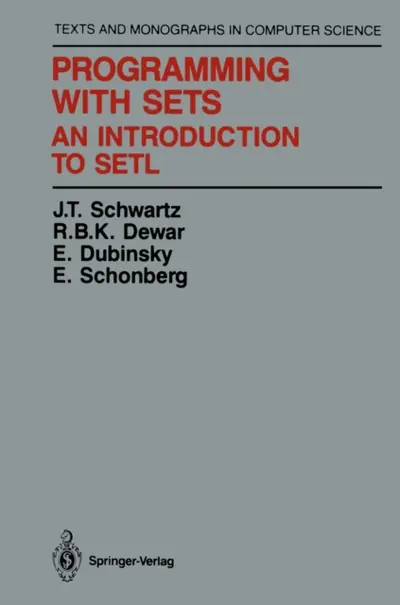
Programming with Sets
An Introduction to SETL
Price and availability
$120.99
Available in: Andorra, Austria, Australia, Belgium, Bulgaria, Canada, Switzerland, Cyprus, Czechia, Germany, Denmark, Estonia, Spain, Finland, France, United Kingdom, Guernsey, Greece, Croatia, Hungary, Ireland, Isle of Man, Iceland, Italy, Jersey, Japan, Liechtenstein, Lithuania, Luxembourg, Latvia, Monaco, Malta, Netherlands, Norway, Poland, Portugal, Romania, Sweden, Slovenia, Slovakia, San Marino, United States, Vatican City, South Africa
Stores: US, UK, Canada, EU, Australia.
Sign in to buyThe price is re-checked by the server before payment.
For personal use under the eBook licence.
- Format
- DRM
- Not stated by the publisher
- Language
- English
- Publisher
- Springer New York
- Published
- 6 December 2012
- ISBN
- 9781461395751
- Subjects
- Compilers, Software Engineering, Compilers and interpreters, Software Engineering
About this book
The programming language SETL is a relatively new member of the so-called "e;very-high-level"e; class of languages, some of whose other well-known mem- bers are LISP, APL, SNOBOL, and PROLOG. These languages all aim to reduce the cost of programming, recognized today as a main obstacle to future progress in the computer field, by allowing direct manipulation of large composite objects, considerably more complex than the integers, strings, etc., available in such well-known mainstream languages as PASCAL, PL/I, ALGOL, and Ada. For this purpose, LISP introduces structured lists as data objects, APL introduces vectors and matrices, and SETL introduces the objects characteristic for it, namely general finite sets and maps. The direct availability of these abstract, composite objects, and of powerful mathematical operations upon them, improves programmer speed and pro- ductivity significantly, and also enhances program clarity and readability. The classroom consequence is that students, freed of some of the burden of petty programming detail, can advance their knowledge of significant algorithms and of broader strategic issues in program development more rapidly than with more conventional programming languages.
Bibliographic data © Gardners Books Ltd.