PDF · English
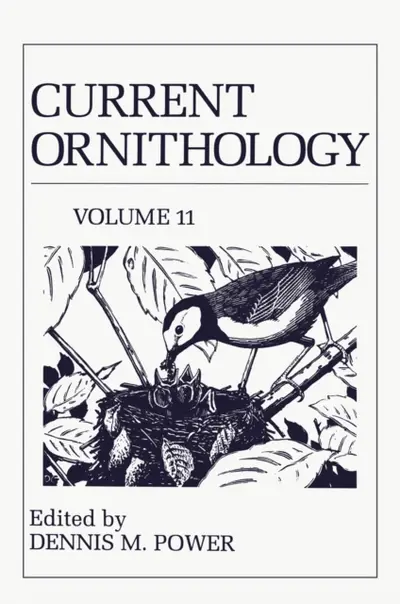
Current Ornithology
Volume 11
Price and availability
$175.99
Available in: Andorra, Austria, Australia, Belgium, Bulgaria, Canada, Switzerland, Cyprus, Czechia, Germany, Denmark, Estonia, Spain, Finland, France, United Kingdom, Guernsey, Greece, Croatia, Hungary, Ireland, Isle of Man, Iceland, Italy, Jersey, Japan, Liechtenstein, Lithuania, Luxembourg, Latvia, Monaco, Malta, Netherlands, Norway, Poland, Portugal, Romania, Sweden, Slovenia, Slovakia, San Marino, United States, Vatican City, South Africa
Stores: US, UK, Canada, EU, Australia.
Sign in to buyThe price is re-checked by the server before payment.
For personal use under the eBook licence.
- Format
- DRM
- Not stated by the publisher
- Language
- English
- Publisher
- Springer US
- Published
- 29 June 2013
- ISBN
- 9781475799125
- Subjects
- Ecological science, the Biosphere, Evolution, Zoology & animal sciences, Birds (ornithology), Applied ecology, Ecological science, the Biosphere, Evolution / Evolutionary biology, Zoology and animal sciences
About this book
In this volume I include chapters on continental population trends, orni- thology's contribution to the habitat concept, social organization outside the breeding season, the role of predation in limiting numbers, and the evolution of prolonged incubation periods. Authors are based in Belgium, the United Kingdom, and the United States. Is there evidence for wholesale population declines in North Ameri- can birds? Robert Askins says yes, with qualifications. Fragmentation of forest causes the population of many forest-interior species to decline, and loss of winter forest habitat in Mexico, Central America, and the Greater Antilles is potentially serious. Trends over the past 25 years are, however, difficult to discern. Grassland and shrubland specialists have likewise diminished over the past quarter century. Askins calls for management of regional landscapes to maintain habitat diversity. As for habitats, William Block and Leonard Brennan review the role of ornithology in developing the concept of "e;habitat."e; Their intention is to stimulate ornithologists to consider habitat as a unifying concept in con- temporary ecology. They describe uses of the habitat concept in basic and experimental ecology. Recent advances in sociobiology stimulated deeper interest in social organization. Erik Matthysen has gathered a diversity of information on social organization outside the breeding season, both in migratory and in nonbreeding resident birds. He discusses populations that continue indi- vidual associations outside the breeding season and site-related aggression (territoriality), and reviews a number of long-term benefits of these behaviors.
Bibliographic data © Gardners Books Ltd.