EPUB · English
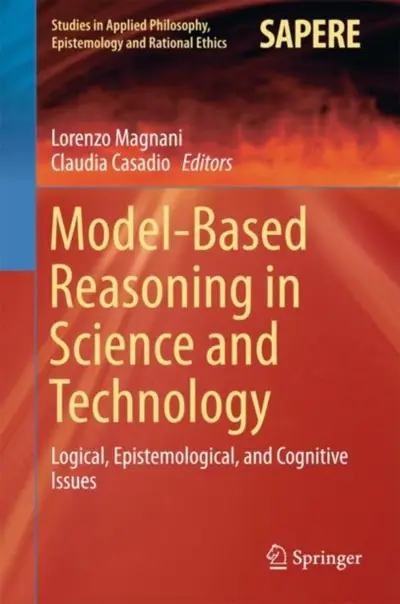
Model-Based Reasoning in Science and Technology
Logical, Epistemological, and Cognitive Issues
- Society & social sciences
- Science & mathematics
- Technology & engineering
- Computing & IT
- Philosophy & religion
Price and availability
$337.99
Available in: Andorra, Austria, Australia, Belgium, Bulgaria, Canada, Switzerland, Cyprus, Czechia, Germany, Denmark, Estonia, Spain, Finland, France, United Kingdom, Guernsey, Greece, Croatia, Hungary, Ireland, Isle of Man, Iceland, Italy, Jersey, Japan, Liechtenstein, Lithuania, Luxembourg, Latvia, Monaco, Malta, Netherlands, Norway, Poland, Portugal, Romania, Sweden, Slovenia, Slovakia, San Marino, United States, Vatican City, South Africa
Stores: US, UK, Canada, EU, Australia.
Sign in to buyThe price is re-checked by the server before payment.
For personal use under the eBook licence.
- Format
- EPUB
- DRM
- Not stated by the publisher
- Language
- English
- Publisher
- Springer International Publishing
- Published
- 1 July 2016
- ISBN
- 9783319389837
- Subjects
- Philosophy: epistemology & theory of knowledge, Philosophy: logic, Cognition & cognitive psychology, Philosophy of science, Engineering: general, Artificial intelligence, Philosophy: epistemology and theory of knowledge, Philosophy: logic, Artificial intelligence (AI)
About this book
This book discusses how scientific and other types of cognition make use of models, abduction, and explanatory reasoning in order to produce important or creative changes in theories and concepts. It includes revised contributions presented during the international conference on Model-Based Reasoning (MBR'015), held on June 25-27 in Sestri Levante, Italy. The book is divided into three main parts, the first of which focuses on models, reasoning and representation. It highlights key theoretical concepts from an applied perspective, addressing issues concerning information visualization, experimental methods and design. The second part goes a step further, examining abduction, problem solving and reasoning. The respective contributions analyze different types of reasoning, discussing various concepts of inference and creativity and their relationship with experimental data. In turn, the third part reports on a number of historical, epistemological and technological issues. By analyzing possible contradictions in modern research and describing representative case studies in experimental research, this part aims at fostering new discussions and stimulating new ideas. All in all, the book provides researchers and graduate students in the field of applied philosophy, epistemology, cognitive science and artificial intelligence alike with an authoritative snapshot of current theories and applications of model-based reasoning.
Bibliographic data © Gardners Books Ltd.