EPUB · English
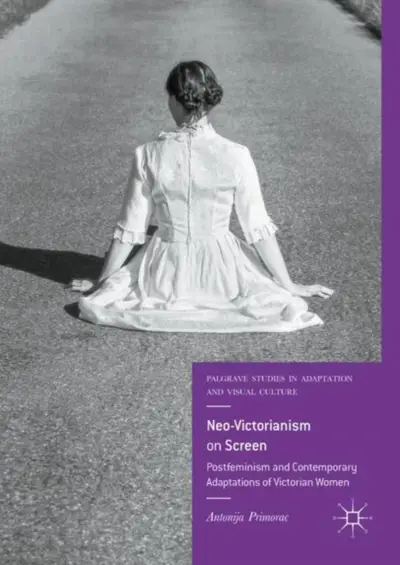
Neo-Victorianism on Screen
Postfeminism and Contemporary Adaptations of Victorian Women
Price and availability
$148.99
Available in: Andorra, Austria, Australia, Belgium, Bulgaria, Canada, Switzerland, Cyprus, Czechia, Germany, Denmark, Estonia, Spain, Finland, France, United Kingdom, Guernsey, Greece, Croatia, Hungary, Ireland, Isle of Man, Iceland, Italy, Jersey, Japan, Liechtenstein, Lithuania, Luxembourg, Latvia, Monaco, Malta, Netherlands, Norway, Poland, Portugal, Romania, Sweden, Slovenia, Slovakia, San Marino, United States, Vatican City, South Africa
Stores: US, UK, Canada, EU, Australia.
Sign in to buyThe price is re-checked by the server before payment.
For personal use under the eBook licence.
- Format
- EPUB
- DRM
- Not stated by the publisher
- Language
- English
- Publisher
- Springer International Publishing
- Published
- 17 November 2017
- ISBN
- 9783319645599
- Subjects
- United Kingdom, Great Britain, c 1800 to c 1900, Film, TV & radio, Literary studies: c 1800 to c 1900, British & Irish history, Cultural studies, Gender studies: women, Western Europe, United Kingdom, Great Britain, Performing arts, Literary studies: c 1800 to c 1900, Cultural studies, European history
About this book
This book broadens the scope of inquiry of neo-Victorian studies by focusing primarily on screen adaptations and appropriations of Victorian literature and culture. More specifically, this monograph spotlights the overlapping yet often conflicting drives at work in representations of Victorian heroines in contemporary film and TV. Primorac's close analyses of screen representations of Victorian women pay special attention to the use of costume and clothes, revealing the tensions between diverse theoretical interventions and generic (often market-oriented) demands. The author elucidates the push and pull between postcolonial critique and nostalgic, often Orientalist spectacle; between feminist textual interventions and postfeminist media images. Furthermore, this book examines neo-Victorianism's relationship with postfeminist media culture and offers an analysis of the politics behind onscreen treatment of Victorian gender roles, family structures, sexuality, and colonial space.
Bibliographic data © Gardners Books Ltd.