PDF · English
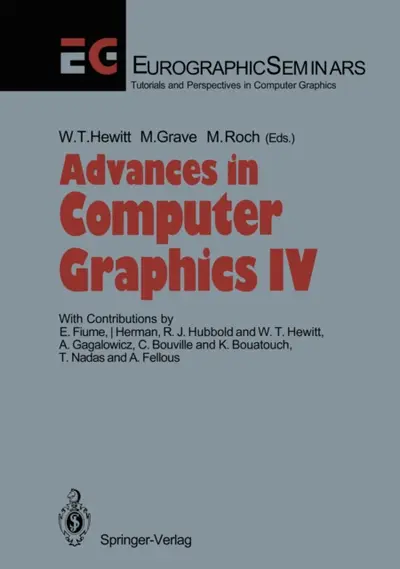
Advances in Computer Graphics IV
Price and availability
$120.99
Available in: Andorra, Austria, Australia, Belgium, Bulgaria, Canada, Switzerland, Cyprus, Czechia, Germany, Denmark, Estonia, Spain, Finland, France, United Kingdom, Guernsey, Greece, Croatia, Hungary, Ireland, Isle of Man, Iceland, Italy, Jersey, Japan, Liechtenstein, Lithuania, Luxembourg, Latvia, Monaco, Malta, Netherlands, Norway, Poland, Portugal, Romania, Sweden, Slovenia, Slovakia, San Marino, United States, Vatican City, South Africa
Stores: US, UK, Canada, EU, Australia.
Sign in to buyThe price is re-checked by the server before payment.
For personal use under the eBook licence.
- Format
- DRM
- Not stated by the publisher
- Language
- English
- Publisher
- Springer Berlin Heidelberg
- Published
- 6 December 2012
- ISBN
- 9783642840609
- Subjects
- Graphical & digital media applications, Cybernetics and systems theory, Geometry, Computational chemistry, Maths for engineers, Computer-aided design (CAD), Graphics programming
About this book
This fourth volume of Advances in Computer Graphics gathers together a selection of the tutorials presented at the EUROGRAPHICS annual conference in Nice, France, Septem- ber 1988. The six contributions cover various disciplines in Computer Graphics, giving either an in-depth view of a specific topic or an updated overview of a large area. Chapter 1, Object-oriented Computer Graphics, introduces the concepts of object ori- ented programming and shows how they can be applied in different fields of Computer Graphics, such as modelling, animation and user interface design. Finally, it provides an extensive bibliography for those who want to know more about this fast growing subject. Chapter 2, Projective Geometry and Computer Graphics, is a detailed presentation of the mathematics of projective geometry, which serves as the mathematical background for all graphic packages, including GKS, GKS-3D and PRIGS. This useful paper gives in a single document information formerly scattered throughout the literature and can be used as a reference for those who have to implement graphics and CAD systems. Chapter 3, GKS-3D and PHIGS: Theory and Practice, describes both standards for 3D graphics, and shows how each of them is better adapted in different typical applications. It provides answers to those who have to choose a basic 3D graphics library for their developments, or to people who have to define their future policy for graphics.
Bibliographic data © Gardners Books Ltd.