EPUB · English
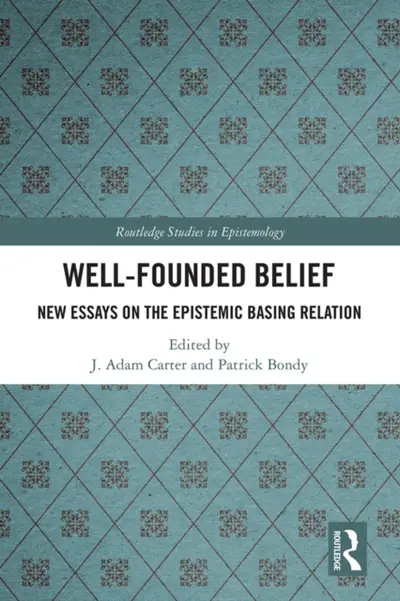
Well-Founded Belief
New Essays on the Epistemic Basing Relation
Price and availability
$64.99
Available in: Andorra, Austria, Australia, Belgium, Bulgaria, Canada, Switzerland, Cyprus, Czechia, Germany, Denmark, Estonia, Spain, Finland, France, United Kingdom, Guernsey, Greece, Croatia, Hungary, Ireland, Isle of Man, Iceland, Italy, Jersey, Japan, Liechtenstein, Lithuania, Luxembourg, Latvia, Monaco, Malta, Netherlands, Norway, Poland, Portugal, Romania, Sweden, Slovenia, Slovakia, San Marino, United States, Vatican City, South Africa
Stores: US, UK, Canada, EU, Australia.
Sign in to buyThe price is re-checked by the server before payment.
For personal use under the eBook licence.
- Format
- EPUB
- DRM
- Not stated by the publisher
- Language
- English
- Publisher
- Taylor & Francis
- Published
- 10 December 2019
- ISBN
- 9781351382434
- Subjects
- Philosophy, Philosophy: epistemology & theory of knowledge, Philosophy of mind, Ethics & moral philosophy, Philosophy: epistemology and theory of knowledge
About this book
Epistemological theories of knowledge and justification draw a crucial distinction between one's simply having good reasons for some belief and one's actually basing one's belief on good reasons. While the most natural kind of account of basing is causal in nature-a belief is based on a reason if and only if the belief is properly caused by the reason-there is hardly any widely accepted, counterexample-free account of the basing relation among contemporary epistemologists. Further inquiry into the nature of the basing relation is therefore of paramount importance for epistemology. Without an acceptable account of the basing relation, epistemological theories remain both crucially incomplete and vulnerable to errors that can arise when authors assume an implausible view of what it takes for beliefs to be held on the basis of reasons.Well-Founded Belief brings together 16 essays written by leading epistemologists to explore this important topic in greater detail. The chapters in this collection are divided into two broad categories: (i) the nature of the basing relation; and (ii) basing and its applications. The chapters in the first section are concerned, principally, with positively characterizing the epistemic basing relation and criticizing extant accounts of it, including extant accounts of the relationship between epistemic basing and propositional and doxastic justification. The latter chapters connect epistemic basing with other topics of interest in epistemology as well as ethics, including: epistemic disjunctivism, epistemic injustice, agency, epistemic conservativism, epistemic grounding, epistemic genealogy, practical reasoning, and practical knowledge.
Bibliographic data © Gardners Books Ltd.