PDF · English
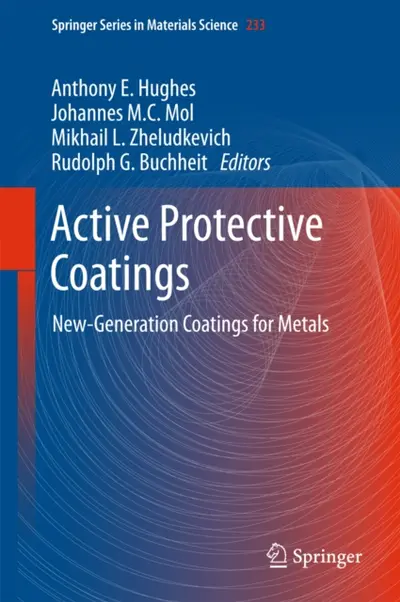
Active Protective Coatings
New-Generation Coatings for Metals
Price and availability
$100.99
Available in: Andorra, Austria, Australia, Belgium, Bulgaria, Canada, Switzerland, Cyprus, Czechia, Germany, Denmark, Estonia, Spain, Finland, France, United Kingdom, Guernsey, Greece, Croatia, Hungary, Ireland, Isle of Man, Iceland, Italy, Jersey, Japan, Liechtenstein, Lithuania, Luxembourg, Latvia, Monaco, Malta, Netherlands, Norway, Poland, Portugal, Romania, Sweden, Slovenia, Slovakia, San Marino, United States, Vatican City, South Africa
Stores: US, UK, Canada, EU, Australia.
Sign in to buyThe price is re-checked by the server before payment.
For personal use under the eBook licence.
- Format
- DRM
- Not stated by the publisher
- Language
- English
- Publisher
- Springer Netherlands
- Published
- 1 March 2016
- ISBN
- 9789401775403
- Subjects
- Surface-coating technology, Metals technology / metallurgy, Materials science, Applied physics, Industrial chemistry and chemical engineering, Tribology (friction and lubrication), Materials science, Engineering applications of surface coatings and films, Testing of materials
About this book
This book coversa broad range of materials science that has been brought to bear on providingsolutions to the challenges of developing self-healing and protective coatingsfor a range of metals. The book has a strong emphasis on characterisationtechniques, particularly new techniques that are beginning to be used in thecoatings area. It features many contributions written by experts from variousindustrial sectors which examine the needs of the sectors and the state of theart.The developmentof self-healing and protective coatings has been an expanding field in recentyears and applies a lot of new knowledge gained from other fields as well asother areas of materials science to the development of coatings. It hasborrowed from fields such as the food and pharmaceutical industries who haveused, polymer techniques, sol-gel science and colloidosome technology for arange encapsulation techniques. It has also borrowed from fields like hydrogenstorage such as from the development of hierarchical and other materials basedon organic templating as nanocontainers for the delivery of inhibitors. Inmaterials science, recent developments in high throughput and othercharacterisation techniques, such as those available from synchrotrons, arebeing increasing used for novel characterisation one only needs to look atthe application of these techniques in self healing polymers to gauge wealth ofnew information that has been gained from these techniques.This work islargely driven by the need to replace environmental pollutants and hazardouschemicals that represent risk to humans such as chromate inhibitors which arestill used in some applications.
Bibliographic data © Gardners Books Ltd.