EPUB · English
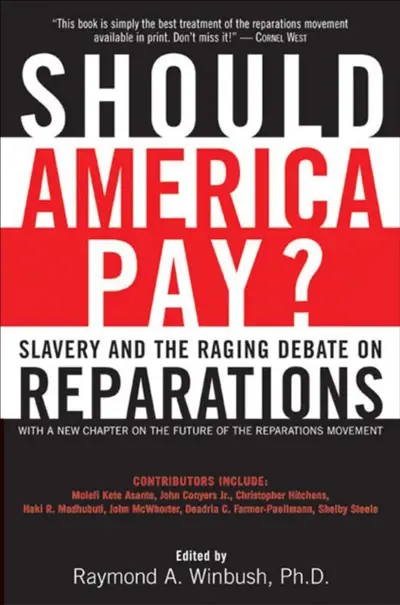
Should America Pay?
Slavery and the Raging Debate on Reparations
Price and availability
$20.99
Available in: Andorra, Austria, Australia, Belgium, Bulgaria, Canada, Switzerland, Cyprus, Czechia, Germany, Denmark, Estonia, Spain, Finland, France, United Kingdom, Guernsey, Greece, Croatia, Hungary, Ireland, Isle of Man, Iceland, Italy, Jersey, Japan, Liechtenstein, Lithuania, Luxembourg, Latvia, Monaco, Malta, Netherlands, Norway, Poland, Portugal, Romania, Sweden, Slovenia, Slovakia, San Marino, United States, Vatican City, South Africa
Stores: US, UK, Canada, EU, Australia.
Sign in to buyThe price is re-checked by the server before payment.
For personal use under the eBook licence.
- Format
- EPUB
- DRM
- Not stated by the publisher
- Language
- English
- Publisher
- HarperCollins
- Published
- 9 July 2010
- ISBN
- 9780062013637
- Subjects
- USA, Biography: general, Social & cultural history, Ethnic studies, Black & Asian studies, Politics & government, Political science & theory, Central government, Human rights & civil liberties law, Ethnic studies / Ethnicity, Law: Human rights and civil liberties
About this book
Growing interest in reparations for African Americans has prompted a range of responses, from lawsuits against major corporations and a march in Washington to an anti-reparations ad campaign. As a result, the link between slavery and contemporary race relations is more potent and obvious than ever. Grassroots organizers, lawmakers, and distinguished academics have embraced the idea that reparations should be pursued vigorously in the courts and legislature. But others ask, Who should pay? And could reparations help heal the wounds of the past?This comprehensive collection -- the only of its kind -- gathers together the seminal essays and key participants in the debate. Pro-reparations essays, including contributions by Congressman John Conyers Jr., Christopher Hitchens, and Professor Molefi Asante, are countered with arguments by Shelby Steele, Armstrong Williams, and John McWhorter, among others. Also featured are important documents, such as the First Congressional Reparations Bill of 1867 and the Dakar Declaration of 2001, as well as a new chapter on the current status and future direction of the movement.
Bibliographic data © Gardners Books Ltd.