PDF · English
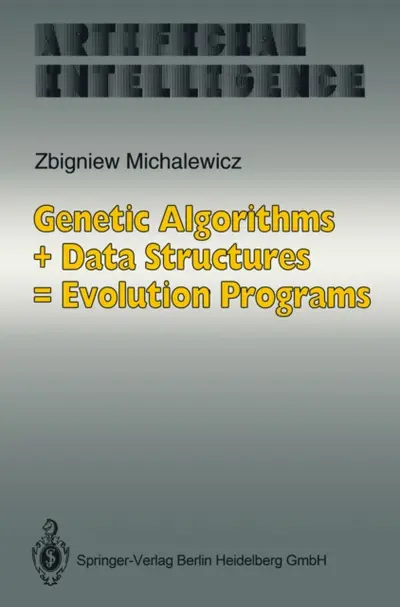
Genetic Algorithms + Data Structures = Evolution Programs
Price and availability
$97.99
Available in: Andorra, Austria, Australia, Belgium, Bulgaria, Canada, Switzerland, Cyprus, Czechia, Germany, Denmark, Estonia, Spain, Finland, France, United Kingdom, Guernsey, Greece, Croatia, Hungary, Ireland, Isle of Man, Iceland, Italy, Jersey, Japan, Liechtenstein, Lithuania, Luxembourg, Latvia, Monaco, Malta, Netherlands, Norway, Poland, Portugal, Romania, Sweden, Slovenia, Slovakia, San Marino, United States, Vatican City, South Africa
Stores: US, UK, Canada, EU, Australia.
Sign in to buyThe price is re-checked by the server before payment.
For personal use under the eBook licence.
- Format
- DRM
- Not stated by the publisher
- Language
- English
- Publisher
- Springer Berlin Heidelberg
- Published
- 29 June 2013
- ISBN
- 9783662028308
- Subjects
- Management decision making, Operational research, Numerical analysis, Computer programming / software engineering, Algorithms and data structures, Software Engineering, Artificial intelligence (AI)
About this book
'What does your Master teach?' asked a visitor. 'Nothing,' said the disciple. 'Then why does he give discourses?' 'He only points the way - he teaches nothing.' Anthony de Mello, One Minute Wisdom During the last three decades there has been a growing interest in algorithms which rely on analogies to natural processes. The emergence of massively par- allel computers made these algorithms of practical interest. The best known algorithms in this class include evolutionary programming, genetic algorithms, evolution strategies, simulated annealing, classifier systems, and neural net- works. Recently (1-3 October 1990) the University of Dortmund, Germany, hosted the First Workshop on Parallel Problem Solving from Nature [164]. This book discusses a subclass of these algorithms - those which are based on the principle of evolution (survival of the fittest). In such algorithms a popu- lation of individuals (potential solutions) undergoes a sequence of unary (muta- tion type) and higher order (crossover type) transformations. These individuals strive for survival: a selection scheme, biased towards fitter individuals, selects the next generation. After some number of generations, the program converges - the best individual hopefully represents the optimum solution. There are many different algorithms in this category. To underline the sim- ilarities between them we use the common term "e;evolution programs"e; .
Bibliographic data © Gardners Books Ltd.