EPUB · English
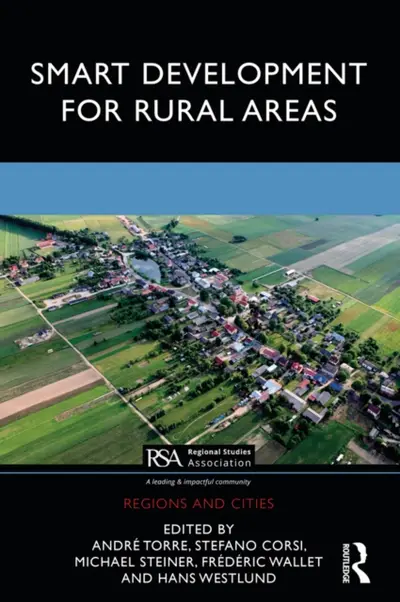
Smart Development for Rural Areas
- Politics & law
- Economics, business & finance
- Nature, environment & geography
- Technology & engineering
- Reference
Price and availability
$63.99
Available in: Andorra, Austria, Australia, Belgium, Bulgaria, Canada, Switzerland, Cyprus, Czechia, Germany, Denmark, Estonia, Spain, Finland, France, United Kingdom, Guernsey, Greece, Croatia, Hungary, Ireland, Isle of Man, Iceland, Italy, Jersey, Japan, Liechtenstein, Lithuania, Luxembourg, Latvia, Monaco, Malta, Netherlands, Norway, Poland, Portugal, Romania, Sweden, Slovenia, Slovakia, San Marino, United States, Vatican City, South Africa
Stores: US, UK, Canada, EU, Australia.
Sign in to buyThe price is re-checked by the server before payment.
For personal use under the eBook licence.
- Format
- EPUB
- DRM
- Not stated by the publisher
- Language
- English
- Publisher
- Taylor & Francis
- Published
- 11 October 2020
- ISBN
- 9781000067019
- Subjects
- EU (European Union), Development studies, Economics of industrial organisation, Agriculture & related industries, Human geography, Rural planning, Civil engineering, surveying & building, Agricultural science, EU (European Union), Public administration / Public policy, Economic geography, Rural planning and policy
About this book
This thought-provoking book questions the framework of the Horizon 2020 strategy and the policies of smart development. It aims to answer the following question: Is there any possibility for a policy of smart development and smart specialization in rural and peri-urban areas? Based on detailed analytical studies, empirical and econometric methods, as well as various European case studies, several conclusions are drawn.Smart development policies are well adapted to the developed or intermediate regions containing at the same time rural and urban areas, but do not really function for the more rural or more peripheral regions. The development policies of rural areas must be adapted to their particular characteristics, to the structure of their economies (agriculture, small firms), as well as in their diversity (distant regions, intermediate regions, rural areas near the urban areas). It appears interesting to exploit natural and cultural amenities, to develop the multifunctional character of the agriculture, to promote territorial innovation under all its forms, to favor the synergies between the various uses of land and space, and to develop the knowledge on the ecological, socioeconomic processes, as well as on the mechanisms of territorial governance.These results are very important because they question the validity of the H2020 policy and the smart development and smart specialization policies and their applicability to the whole European area, and not only for the most urban and rich areas. It will be valuable reading for students, researchers and policy-makers in regional development, rural studies, spatial planning and economic geography.
Bibliographic data © Gardners Books Ltd.