PDF · English
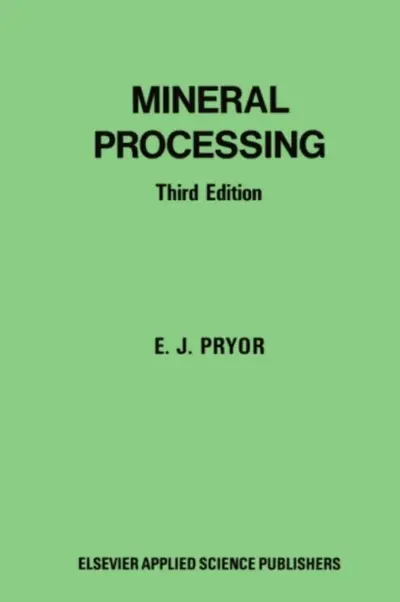
Mineral Processing
Price and availability
$120.99
Available in: Andorra, Austria, Australia, Belgium, Bulgaria, Canada, Switzerland, Cyprus, Czechia, Germany, Denmark, Estonia, Spain, Finland, France, United Kingdom, Guernsey, Greece, Croatia, Hungary, Ireland, Isle of Man, Iceland, Italy, Jersey, Japan, Liechtenstein, Lithuania, Luxembourg, Latvia, Monaco, Malta, Netherlands, Norway, Poland, Portugal, Romania, Sweden, Slovenia, Slovakia, San Marino, United States, Vatican City, South Africa
Stores: US, UK, Canada, EU, Australia.
Sign in to buyThe price is re-checked by the server before payment.
For personal use under the eBook licence.
- Format
- DRM
- Not stated by the publisher
- Language
- English
- Publisher
- Springer Netherlands
- Published
- 6 December 2012
- ISBN
- 9789401029414
- Subjects
- Mineralogy & gems, Earth sciences, Metals technology / metallurgy, Earth sciences
About this book
textbook. Basic description is attempted, and the bibliography has been specifically chosen to guide the reader toward a fuller treatment of his special- ised interests. No fully satisfactory term has yet emerged to describe the processing of minerals, which is also called "e;ore dressing"e;, "e;mineral dressing"e;, "e;mineral engineering"e; and, in the University of London degree course "e;mineral technology"e;. The dressing of ores was an excellent description of the older processes which aimed to break down rock to appropriate sizes, grade it, and separate the heavy fraction from the light one in each grade or size by gravity methods. The work done in the mill today goes far beyond these simple operations, and requires some knowledge of physical chemistry, particularly the branches which deal with the physics and chemistry of surfaces and of the interphase between solid particle and the surrounding liquid. At the same time, the engineer must not become so absorbed in the study of fundamental and applied technology as a physico-chemical science that he overlooks the mechanical, economic, and humanistic aspects oli his work. He is an engineer, a chemist, a physicist, and an administrator and, as such, should have a sound scientifj. c and cultural education. Technically, his work is to extract the valuable minerals from the ore sent to his mill; economically, it is to balance all the financial costs and returns in such a way as to ensure the maximum profit from the operation.
Bibliographic data © Gardners Books Ltd.