EPUB · English
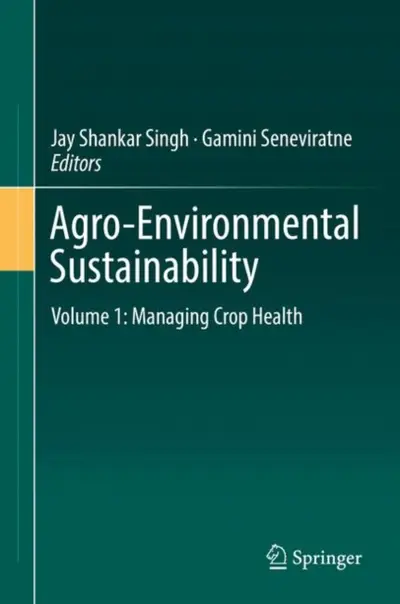
Agro-Environmental Sustainability
Volume 1: Managing Crop Health
Price and availability
$120.99
Available in: Andorra, Austria, Australia, Belgium, Bulgaria, Canada, Switzerland, Cyprus, Czechia, Germany, Denmark, Estonia, Spain, Finland, France, United Kingdom, Guernsey, Greece, Croatia, Hungary, Ireland, Isle of Man, Iceland, Italy, Jersey, Japan, Liechtenstein, Lithuania, Luxembourg, Latvia, Monaco, Malta, Netherlands, Norway, Poland, Portugal, Romania, Sweden, Slovenia, Slovakia, San Marino, United States, Vatican City, South Africa
Stores: US, UK, Canada, EU, Australia.
Sign in to buyThe price is re-checked by the server before payment.
For personal use under the eBook licence.
- Format
- EPUB
- DRM
- Not stated by the publisher
- Language
- English
- Publisher
- Springer International Publishing
- Published
- 14 February 2017
- ISBN
- 9783319497242
- Subjects
- Chemistry, Ecological science, the Biosphere, Microbiology (non-medical), Soil science, sedimentology, Sustainability, Environmental science, engineering & technology, Agricultural science, Environmental chemistry, Ecological science, the Biosphere, Microbiology (non-medical), Sustainability, Agricultural science, Soil science and management
About this book
This two-volume work is a testament to the increasing interest in the role of microbes in sustainable agriculture and food security. Advances in microbial technologies are explored in chapters dealing with topics such as carbon sequestration, soil fertility management, sustainable crop production, and microbial signaling networks. Volume I is a collection of research findings that invites readers to examine the application of microbes in reinstating degraded ecosystems and also in establishing sustainable croplands. Highly readable entries attempt to close the knowledge gap between soil microbial associations and sustainable agriculture. An increase in the global population with changing climate is leading to environments of various abiotic and biotic stresses for agricultural crops. It therefore becomes important to identify the techniques to improve soil fertility and function using different microbial groups such as actinobacteria, microalgae, fluorescent pseudomonads and cyanobacterial systems. These are examined in this volume in greater detail. This work is a significant contribution to research in this increasingly important discipline, and will appeal to researchers in microbiology, agriculture, environmental sciences, and soil and crop sciences.
Bibliographic data © Gardners Books Ltd.