PDF · English
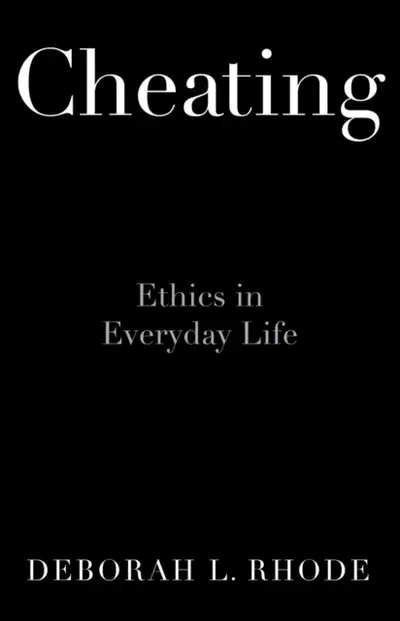
Cheating
Ethics in Everyday Life
Price and availability
$20.99
Available in: Andorra, Austria, Australia, Belgium, Bulgaria, Canada, Switzerland, Cyprus, Czechia, Germany, Denmark, Estonia, Spain, Finland, France, United Kingdom, Guernsey, Greece, Croatia, Hungary, Ireland, Isle of Man, Iceland, Italy, Jersey, Japan, Liechtenstein, Lithuania, Luxembourg, Latvia, Monaco, Malta, Netherlands, Norway, Poland, Portugal, Romania, Sweden, Slovenia, Slovakia, San Marino, United States, Vatican City, South Africa
Stores: US, UK, Canada, EU, Australia.
Sign in to buyThe price is re-checked by the server before payment.
For personal use under the eBook licence.
- Format
- DRM
- Not stated by the publisher
- Language
- English
- Publisher
- Oxford University Press
- Published
- 18 October 2017
- ISBN
- 9780190672430
- Subjects
- USA, Business ethics & social responsibility, Legal ethics & professional conduct, Intellectual property law, United States of America, USA, Business ethics and social responsibility, Legal ethics and professional conduct, Intellectual property law
About this book
Cheating is deeply embedded in everyday life. The costs of the most common forms of cheating total close to a trillion dollars annually. Part of the problem is that many individuals fail to see such behavior as a serious problem. "e;Everyone does it"e; is a common rationalization, and one that comes uncomfortably close to the truth. That perception is also self-perpetuating. The more that individuals believe that cheating is widespread, the easier it becomes to justify. Yet what is most notable about analysis of the problem is how little there is of it. Whether or not Americans are cheating more, they appear to be worrying about it less. In Cheating, eminent legal scholar Deborah L. Rhode offers the only recent comprehensive account of cheating in everyday life and the strategies necessary to address it. Because cheating is highly situational, Rhode drills down on its most common forms in sports, organizations, taxes, academia, copyright infringement, marriage, and insurance and mortgages. Cheating also reviews strategies necessary to address the pervasiveness and persistence of cheating in these contexts. We clearly need more cultural reinforcement of ethical conduct. Efforts need to begin early, with values education by parents, teachers, and other role models who can display and reinforce moral behaviors. Organizations need to create ethical cultures, in which informal norms, formal policies, and reward structures all promote integrity. People also need more moral triggers that remind them of their own values. Equally important are more effective enforcement structures, including additional resources and stiffer sanctions. Finally, all of us need to take more responsibility for combatting cheating. We need not only to subject our own conduct to more demanding standards, but also to assume a greater obligation to prevent and report misconduct. Sustaining a culture that actively discourages cheating is a collective responsibility, and one in which we all have a substantial stake.
Bibliographic data © Gardners Books Ltd.