PDF · English
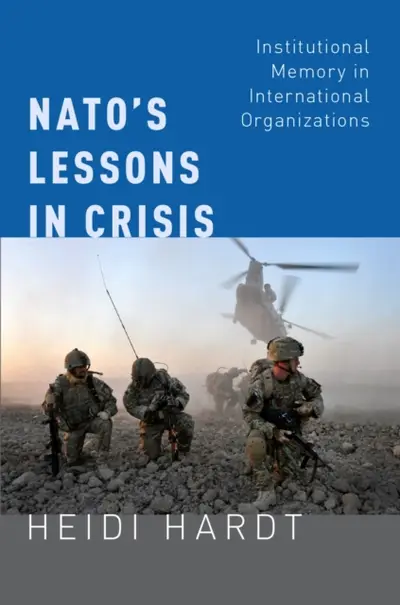
NATO's Lessons in Crisis
Institutional Memory in International Organizations
Price and availability
$41.99
Available in: Andorra, Austria, Australia, Belgium, Bulgaria, Canada, Switzerland, Cyprus, Czechia, Germany, Denmark, Estonia, Spain, Finland, France, United Kingdom, Guernsey, Greece, Croatia, Hungary, Ireland, Isle of Man, Iceland, Italy, Jersey, Japan, Liechtenstein, Lithuania, Luxembourg, Latvia, Monaco, Malta, Netherlands, Norway, Poland, Portugal, Romania, Sweden, Slovenia, Slovakia, San Marino, United States, Vatican City, South Africa
Stores: US, UK, Canada, EU, Australia.
Sign in to buyThe price is re-checked by the server before payment.
For personal use under the eBook licence.
- Format
- DRM
- Not stated by the publisher
- Language
- English
- Publisher
- Oxford University Press
- Published
- 2 April 2018
- ISBN
- 9780190672195
- Subjects
- NATO, International relations, International institutions, NATO (North Atlantic Treaty Organisation), International relations, International institutions / intergovernmental organizations
About this book
In crisis management operations, strategic errors can cost lives. Some international organizations (IOs) learn from these failures whereas others tend to repeat them. Given that they have high rates of turnover, how is it possible that any IO retains knowledge about the past? This book introduces an argument for how and why IOs develop institutional memory from their efforts to manage crises. Findings indicate that the design of an IO's learning infrastructure (e.g. lessons learned offices and databases) can inadvertently disincentivize IO elites from using it to share knowledge about strategic errors. Elites - high-level officials in IOs - perceive reporting to be a risky endeavour. In response, they develop institutional memory by creating and using informal processes, including transnational interpersonal networks, private documentation and conversations during crisis management exercises. The result is an institutional memory that is highly dependent on only a handful of individuals. The book draws on the author's interviews and a survey experiment with 120 NATO elites across four countries. Cases of NATO crisis management in Afghanistan, Libya and Ukraine further illustrate the development of institutional memory. Findings challenge existing research on organizational learning by suggesting that formal learning processes alone are insufficient for ensuring that learning happens. The book also offers recommendations to policymakers for strengthening the learning capacity of IOs.
Bibliographic data © Gardners Books Ltd.