EPUB · English
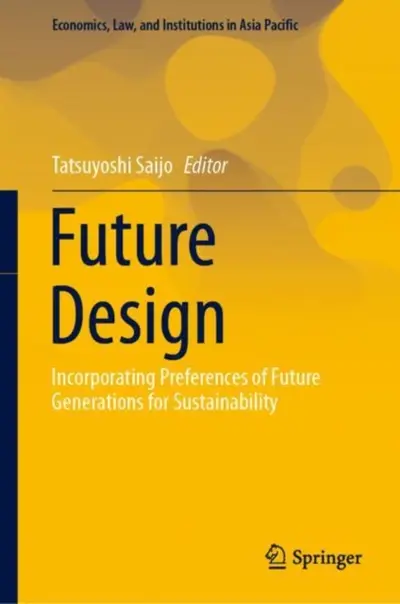
Future Design
Incorporating Preferences of Future Generations for Sustainability
- Society & social sciences
- Politics & law
- Economics, business & finance
- Science & mathematics
- Nature, environment & geography
- Technology & engineering
Price and availability
$148.99
Available in: Andorra, Austria, Australia, Belgium, Bulgaria, Canada, Switzerland, Cyprus, Czechia, Germany, Denmark, Estonia, Spain, Finland, France, United Kingdom, Guernsey, Greece, Croatia, Hungary, Ireland, Isle of Man, Iceland, Italy, Jersey, Japan, Liechtenstein, Lithuania, Luxembourg, Latvia, Monaco, Malta, Netherlands, Norway, Poland, Portugal, Romania, Sweden, Slovenia, Slovakia, San Marino, United States, Vatican City, South Africa
Stores: US, UK, Canada, EU, Australia.
Sign in to buyThe price is re-checked by the server before payment.
For personal use under the eBook licence.
- Format
- EPUB
- DRM
- Not stated by the publisher
- Language
- English
- Publisher
- Springer Nature Singapore
- Published
- 25 July 2020
- ISBN
- 9789811554070
- Subjects
- Social welfare & social services, Central government policies, Regional government, Industry & industrial studies, Energy industries & utilities, Game theory, Sustainability, Environmental science, engineering & technology, Social welfare, social policy and social services, Regional, state and other local government, Energy industries and utilities, Game theory, Sustainability
About this book
This book discusses imaginary future generations and how current decision-making will influence those future generations. Markets and democracies focus on the present and therefore tend to make us forget that we are living in the present, with ancestors preceding and descendants succeeding us. Markets are excellent devices to equate supply and demand in the short term, but not for allocating resources between current and future generations, since future generations do not exist yet. Democracy is also not "e;applicable"e; for future generations, since citizens vote for candidates who will serve members of their, i.e., the current, generation. In order to overcome these shortcomings, the authors discusses imaginary future generations and future ministries in the context of current decision-making in fields such as the environment, urban management, forestry, water management, and finance. The idea of imaginary future generations comes from the Native American Iroquois, who had strong norms that compelled them to incorporate the interests of people seven generations ahead when making decisions.
Bibliographic data © Gardners Books Ltd.