PDF · English
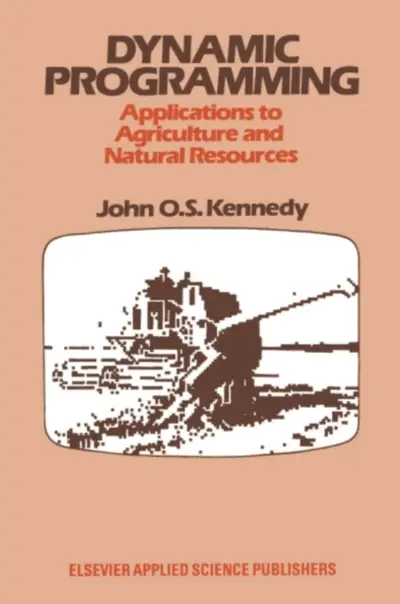
Dynamic Programming
Applications to Agriculture and Natural Resources
Price and availability
$60.99
Available in: Andorra, Austria, Australia, Belgium, Bulgaria, Canada, Switzerland, Cyprus, Czechia, Germany, Denmark, Estonia, Spain, Finland, France, United Kingdom, Guernsey, Greece, Croatia, Hungary, Ireland, Isle of Man, Iceland, Italy, Jersey, Japan, Liechtenstein, Lithuania, Luxembourg, Latvia, Monaco, Malta, Netherlands, Norway, Poland, Portugal, Romania, Sweden, Slovenia, Slovakia, San Marino, United States, Vatican City, South Africa
Stores: US, UK, Canada, EU, Australia.
Sign in to buyThe price is re-checked by the server before payment.
For personal use under the eBook licence.
- Format
- DRM
- Not stated by the publisher
- Language
- English
- Publisher
- Springer Netherlands
- Published
- 6 December 2012
- ISBN
- 9789400941915
- Subjects
- Interdisciplinary studies, Miscellaneous items, Interdisciplinary studies
About this book
Humans interact with and are part of the mysterious processes of nature. Inevitably they have to discover how to manage the environment for their long-term survival and benefit. To do this successfully means learning something about the dynamics of natural processes, and then using the knowledge to work with the forces of nature for some desired outcome. These are intriguing and challenging tasks. This book describes a technique which has much to offer in attempting to achieve the latter task. A knowledge of dynamic programming is useful for anyone interested in the optimal management of agricultural and natural resources for two reasons. First, resource management problems are often problems of dynamic optimization. The dynamic programming approach offers insights into the economics of dynamic optimization which can be explained much more simply than can other approaches. Conditions for the optimal management of a resource can be derived using the logic of dynamic programming, taking as a starting point the usual economic definition of the value of a resource which is optimally managed through time. This is set out in Chapter I for a general resource problem with the minimum of mathematics. The results are related to the discrete maximum principle of control theory. In subsequent chapters dynamic programming arguments are used to derive optimality conditions for particular resources.
Bibliographic data © Gardners Books Ltd.