PDF · English
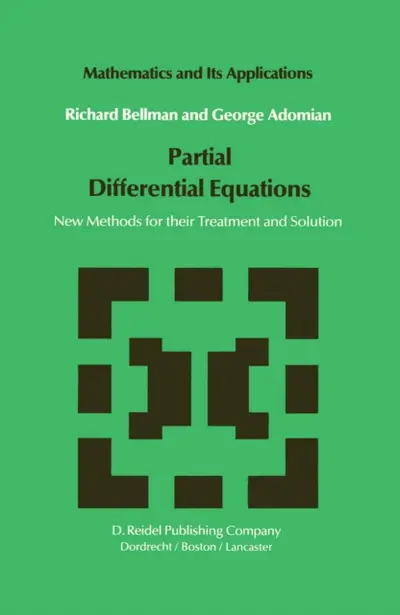
Partial Differential Equations
New Methods for Their Treatment and Solution
Price and availability
$120.99
Available in: Andorra, Austria, Australia, Belgium, Bulgaria, Canada, Switzerland, Cyprus, Czechia, Germany, Denmark, Estonia, Spain, Finland, France, United Kingdom, Guernsey, Greece, Croatia, Hungary, Ireland, Isle of Man, Iceland, Italy, Jersey, Japan, Liechtenstein, Lithuania, Luxembourg, Latvia, Monaco, Malta, Netherlands, Norway, Poland, Portugal, Romania, Sweden, Slovenia, Slovakia, San Marino, United States, Vatican City, South Africa
Stores: US, UK, Canada, EU, Australia.
Sign in to buyThe price is re-checked by the server before payment.
For personal use under the eBook licence.
- Format
- DRM
- Not stated by the publisher
- Language
- English
- Publisher
- Springer Netherlands
- Published
- 6 December 2012
- ISBN
- 9789400952096
- Subjects
- Calculus & mathematical analysis, Calculus and mathematical analysis
About this book
The purpose of this book is to present some new methods in the treatment of partial differential equations. Some of these methods lead to effective numerical algorithms when combined with the digital computer. Also presented is a useful chapter on Green's functions which generalizes, after an introduction, to new methods of obtaining Green's functions for partial differential operators. Finally some very new material is presented on solving partial differential equations by Adomian's decomposition methodology. This method can yield realistic computable solutions for linear or non- linear cases even for strong nonlinearities, and also for deterministic or stochastic cases - again even if strong stochasticity is involved. Some interesting examples are discussed here and are to be followed by a book dealing with frontier applications in physics and engineering. In Chapter I, it is shown that a use of positive operators can lead to monotone convergence for various classes of nonlinear partial differential equations. In Chapter II, the utility of conservation technique is shown. These techniques are suggested by physical principles. In Chapter III, it is shown that dyn~mic programming applied to variational problems leads to interesting classes of nonlinear partial differential equations. In Chapter IV, this is investigated in greater detail. In Chapter V, we show. that the use of a transformation suggested by dynamic programming leads to a new method of successive approximations.
Bibliographic data © Gardners Books Ltd.