PDF · English
Ex-centric Cinema
Giorgio Agamben and Film Archaeology
Price and availability
$36.99
Available in: Andorra, Austria, Australia, Belgium, Bulgaria, Canada, Switzerland, Cyprus, Czechia, Germany, Denmark, Estonia, Spain, Finland, France, United Kingdom, Guernsey, Greece, Croatia, Hungary, Ireland, Isle of Man, Iceland, Italy, Jersey, Japan, Liechtenstein, Lithuania, Luxembourg, Latvia, Monaco, Malta, Netherlands, Norway, Poland, Portugal, Romania, Sweden, Slovenia, Slovakia, San Marino, United States, Vatican City, South Africa
Stores: US, UK, Canada, EU, Australia.
Sign in to buyThe price is re-checked by the server before payment.
For personal use under the eBook licence.
- Format
- DRM
- Not stated by the publisher
- Language
- English
- Publisher
- Bloomsbury Publishing (USA)
- Published
- 20 October 2016
- Pages
- 272
- ISBN
- 9781628922387
- Subjects
- Film theory & criticism, Philosophy, ATFA, QD
About this book
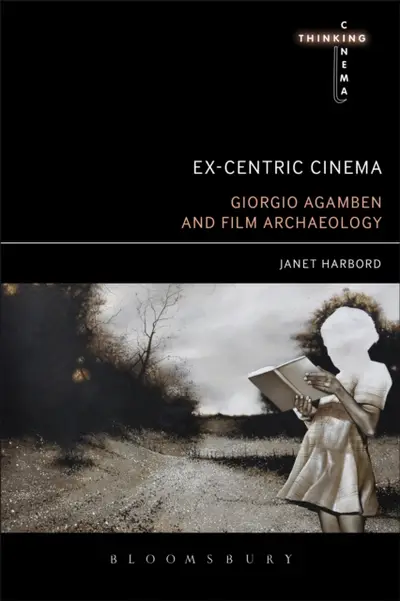
In the beginning, cinema was an encounter between humans, images and machine technology, revealing a stream of staccato gestures, micrographic worlds, and landscapes seen from above and below. In this sense, cinema's potency was its ability to bring other, non-human modes of being into view, to forge an encounter between multiple realities that nonetheless co-exist. Yet the story of cinema became (through its institutionalization) one in which the human swiftly assumed centrality through the literary crafting of story, character and the expression of interiority. Ex-centric Cinema takes an archaeological approach to the study of cinema through the writings of philosopher Giorgio Agamben, arguing that whilst we have a century-long tradition of cinema, the possibility of what cinema may have become is not lost, but co-exists in the present as an unexcavated potential. The term given to this history is ex-centric cinema, describing a centre-less moving image culture where animals, children, ghosts and machines are privileged vectors, where film is always an incomplete project, and where audiences are a coming community of ephemeral connections and links. Discussing such filmmakers as Harun Farocki, the Lumiere Brothers, Guy Debord and Wong Kar-wai, Janet Harbord draws connections with Agamben to propose a radically different way of thinking about cinema.
Bibliographic data © Gardners Books Ltd.