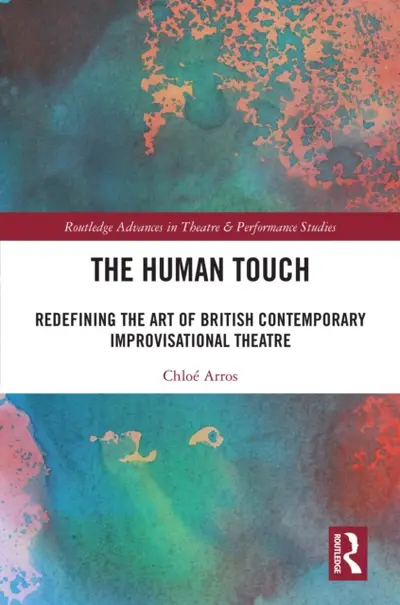
PDF · English
Human Touch
Redefining the Art of British Contemporary Improvisational Theatre
Price and availability
$64.99
Available in: Andorra, Austria, Australia, Belgium, Bulgaria, Canada, Switzerland, Cyprus, Czechia, Germany, Denmark, Estonia, Spain, Finland, France, United Kingdom, Guernsey, Greece, Croatia, Hungary, Ireland, Isle of Man, Iceland, Italy, Jersey, Japan, Liechtenstein, Lithuania, Luxembourg, Latvia, Monaco, Malta, Netherlands, Norway, Poland, Portugal, Romania, Sweden, Slovenia, Slovakia, San Marino, United States, Vatican City, South Africa
Stores: US, UK, Canada, EU, Australia.
Sign in to buyThe price is re-checked by the server before payment.
For personal use under the eBook licence.
- Format
- DRM
- Not stated by the publisher
- Language
- English
- Publisher
- Taylor & Francis
- Published
- 27 September 2024
- ISBN
- 9781040097298
- Subjects
- United Kingdom, Great Britain, Performance art, Theatre studies, Physiological & neuro-psychology, biopsychology, United Kingdom, Great Britain, Theatre studies, Physiological psychology, neuropsychology, biopsychology, Cognition and cognitive psychology
About this book
The Human Touch is a book focused on the creative processes at work in British contemporary improvisational theatre and how these processes draw on the humanity of the participants: their cognitive abilities, their lives, and their relationships to each other. Vulnerability is a main feature of both the book and of improvisational theatre, both part of the hurdles that improvisers face and a creative tool. Through a study of improvisation and vulnerability, the book teaches us both what makes improvisational theatre so human and opens the door to a reflection about how to use humanity and human emotions in performance. Most importantly, it delves into the cognitive and physiological processes at work in improvisation, a topic which is missing from most manuals and studies offered to students. This book is addressed to theatre students and provides both an important overview of the form's history and a challenge to what is usually taught about improvisation.
Bibliographic data © Gardners Books Ltd.