EPUB · English
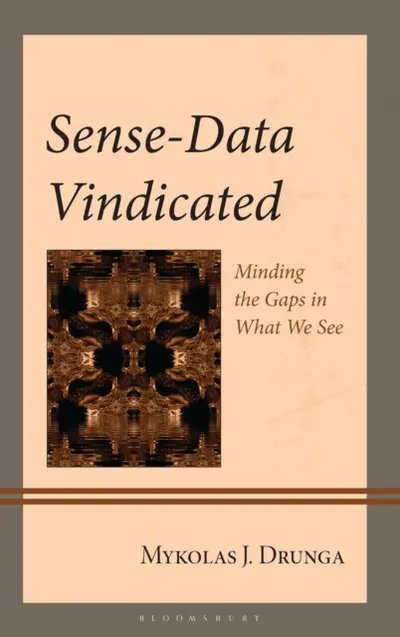
Sense-Data Vindicated
Minding the Gaps in What We See
Price and availability
$103.99
Available in: Andorra, Austria, Australia, Belgium, Bulgaria, Canada, Switzerland, Cyprus, Czechia, Germany, Denmark, Estonia, Spain, Finland, France, United Kingdom, Guernsey, Greece, Croatia, Hungary, Ireland, Isle of Man, Iceland, Italy, Jersey, Japan, Liechtenstein, Lithuania, Luxembourg, Latvia, Monaco, Malta, Netherlands, Norway, Poland, Portugal, Romania, Sweden, Slovenia, Slovakia, San Marino, United States, Vatican City, South Africa
Stores: US, UK, Canada, EU, Australia.
Sign in to buyThe price is re-checked by the server before payment.
For personal use under the eBook licence.
- Format
- EPUB
- DRM
- Not stated by the publisher
- Language
- English
- Publisher
- Bloomsbury Publishing (USA)
- Published
- 20 August 2026
- Pages
- 288
- ISBN
- 9781978760394
- Subjects
- Philosophy: metaphysics & ontology, Philosophy: epistemology & theory of knowledge, Philosophy of mind, Perception, JMR, QDTJ, QDTK, QDTM
About this book
In order to solve the perceptual time-gap problem, this book embraces Idealism and acknowledges the existence of sense-data at the root of perceiving physical objects.Of all the multiple arguments for introducing sense-data as objects of sensory awareness, the Time-Gap Argument remains persistently puzzling. Since the Middle Ages, scholars have wondered about phenomena such as the light we see from stars far away, and the time-gap problem has resisted a definitive solution. Examining most of the arguments advanced since the beginning of the twentieth century both for and against the admission of sense-data, Mykolas J. Drunga argues that the problem cannot be solved by denying that the things we see must exist at the time we see them or by claiming we can see deeply into the past. Instead, we will solve it by realizing that what keeps the universe in existence is an eternal spirit. This radical conclusion, in conversation with the Idealist philosophers Leibniz and Berkeley, requires taking a first indispensable step--acknowledging the existence of sense-data at the root of perceiving physical objects. Drunga vindicates a Direct Realist Subjective Idealism, which alone allows perception of the world to be both possible and understandable. If Subjective Idealism is thus a necessary condition for the possibility and intelligibility of sensory perception, we thereby have a strong proof of Idealism's truth. Ultimately, to be just is to perceive (to be on the way toward coming to know something) or to be perceived (to be on the way toward becoming known to someone).
Bibliographic data © Gardners Books Ltd.