EPUB · English
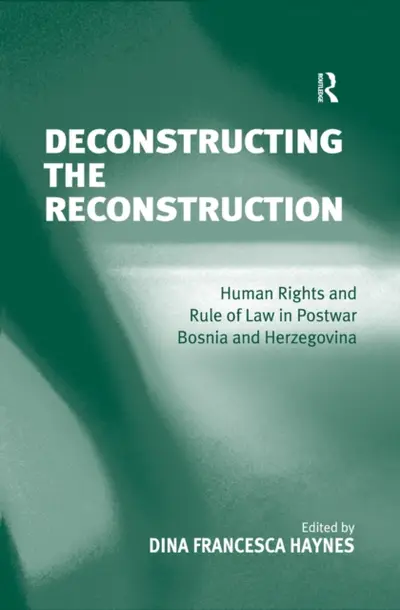
Deconstructing the Reconstruction
Human Rights and Rule of Law in Postwar Bosnia and Herzegovina
Price and availability
$78.99
Available in: Andorra, Austria, Australia, Belgium, Bulgaria, Canada, Switzerland, Cyprus, Czechia, Germany, Denmark, Estonia, Spain, Finland, France, United Kingdom, Guernsey, Greece, Croatia, Hungary, Ireland, Isle of Man, Iceland, Italy, Jersey, Japan, Liechtenstein, Lithuania, Luxembourg, Latvia, Monaco, Malta, Netherlands, Norway, Poland, Portugal, Romania, Sweden, Slovenia, Slovakia, San Marino, United States, Vatican City, South Africa
Stores: US, UK, Canada, EU, Australia.
Sign in to buyThe price is re-checked by the server before payment.
For personal use under the eBook licence.
- Format
- EPUB
- DRM
- Not stated by the publisher
- Language
- English
- Publisher
- Taylor & Francis
- Published
- 5 December 2016
- ISBN
- 9781351945882
- Subjects
- Bosnia-Herzegovina, European history, Human rights, Jurisprudence & general issues, International human rights law, Bosnia-Herzegovina, Public international law: human rights, Public international law: international organizations and institutions, Administrative jurisdiction and public administration
About this book
Bringing together a range of contributors from multiple countries, this interdisciplinary volume offers a unique field view of the rule of law and human rights reform in the reconciliation and reconstruction process. The contributors all worked in Bosnia and Herzegovina during the ten years after the Dayton Peace Accords were signed; here they pause to analyze and critique the work they did. The contributors offer insights from within a variety of international organizations, including the Office of the High Representative, the Organization for Security and Cooperation and Europe, and the United Nations. Allowing those who were in the field to identify, discuss and reflect upon the programmes and policies, the collection reveals how the programmes were created, what laws they were pursuant to, and what alternatives were rejected and why. The authors not only assess both the positive and negative aspects and outcomes of their work, but also comment on lessons learned for future post-conflict reconstruction scenarios.
Bibliographic data © Gardners Books Ltd.