PDF · English
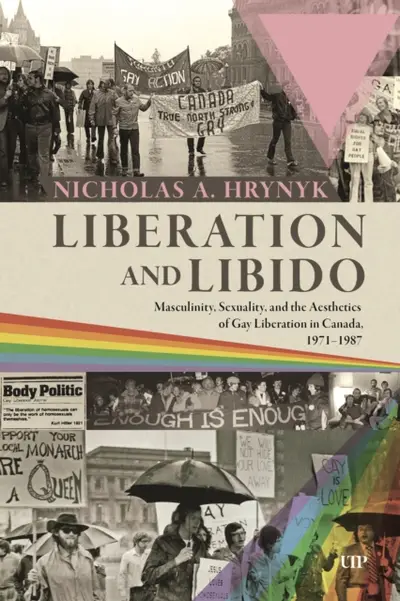
Liberation and Libido
Masculinity, Sexuality, and the Aesthetics of Gay Liberation in Canada, 1971-1987
Price and availability
$29.99
Available in: Andorra, Austria, Australia, Belgium, Bulgaria, Canada, Switzerland, Cyprus, Czechia, Germany, Denmark, Estonia, Spain, Finland, France, United Kingdom, Guernsey, Greece, Croatia, Hungary, Ireland, Isle of Man, Iceland, Italy, Jersey, Japan, Liechtenstein, Lithuania, Luxembourg, Latvia, Monaco, Malta, Netherlands, Norway, Poland, Portugal, Romania, Sweden, Slovenia, Slovakia, San Marino, United States, Vatican City, South Africa
Stores: US, UK, Canada, EU, Australia.
Sign in to buyThe price is re-checked by the server before payment.
For personal use under the eBook licence.
- Format
- DRM
- Not stated by the publisher
- Language
- English
- Publisher
- University of Toronto Press
- Published
- 23 January 2026
- Pages
- 296
- ISBN
- 9781487535520
- Subjects
- Canada, c 1970 to c 1980, c 1980 to c 1990, 5SG, History of the Americas, Postwar 20th century history, from c 1945 to c 2000, Media studies, Urban communities, Gender studies: men, Gay & Lesbian studies, Canada, 3MPQV, 3MPQX, 5PSG, JBCT, JBSD, JBSF2, JBSJ, NH, NHK
About this book
Liberation and Libido delves into the vibrant, messy, and deeply political history of gay liberation in Canada, exploring how The Body Politic (TBP) shaped and challenged ideas of gay male masculinity - and gender more broadly - between 1971 and 1987. As one of Canada's largest lesbian and gay activist periodicals, TBP was a lively forum where people debated, defended, and dismantled notions of gender. It also shed light on the divergent representations of masculinity - some reinforcing queer patriarchal ideas of whiteness, race, health, disability, and class, while others challenged and pushed back against the status quo.Through an in-depth exploration into TBP s images, advertisements, letters, classified ads, and editorial content, Hrynyk unravels how shifting attitudes on masculinity, race, class, ability, and health played out on its pages. Two guiding frameworks underpin this analysis: queer patriarchy, which highlights the dominance of whiteness and masculinity within gay male spaces, and queer style, which captures the playful, rebellious manner in which queer culture appropriated and rejected mainstream gender and sexual norms.This book presents TBP not simply as an activist newspaper but rather as a battleground where masculinity was contested, reshaped, and reimagined. From radical manifestos to steamy personal ads, every page of TBP reflected the push-and-pull between liberation and assimilation, activism and commerce. Liberation and Libido invites readers to reevaluate our understanding of masculinity, power, and desire in the context of queer resistance in Canadian history.
Bibliographic data © Gardners Books Ltd.