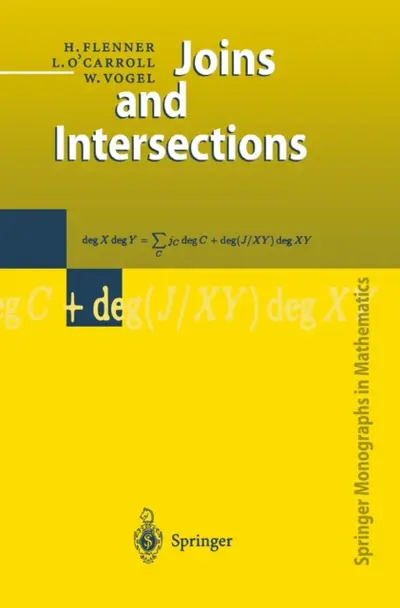
PDF · English
Joins and Intersections
Price and availability
$120.99
Available in: Andorra, Austria, Australia, Belgium, Bulgaria, Canada, Switzerland, Cyprus, Czechia, Germany, Denmark, Estonia, Spain, Finland, France, United Kingdom, Guernsey, Greece, Croatia, Hungary, Ireland, Isle of Man, Iceland, Italy, Jersey, Japan, Liechtenstein, Lithuania, Luxembourg, Latvia, Monaco, Malta, Netherlands, Norway, Poland, Portugal, Romania, Sweden, Slovenia, Slovakia, San Marino, United States, Vatican City, South Africa
Stores: US, UK, Canada, EU, Australia.
Sign in to buyThe price is re-checked by the server before payment.
For personal use under the eBook licence.
- Format
- DRM
- Not stated by the publisher
- Language
- English
- Publisher
- Springer Berlin Heidelberg
- Published
- 29 June 2013
- ISBN
- 9783662038178
- Subjects
- Algebra, Geometry, Algebraic geometry, Algebra, Geometry, Algebraic geometry
About this book
Dedicated to the memory of Wolfgang Classical Intersection Theory (see for example Wei! [Wei]) treats the case of proper intersections, where geometrical objects (usually subvarieties of a non- singular variety) intersect with the expected dimension. In 1984, two books appeared which surveyed and developed work by the individual authors, co- workers and others on a refined version of Intersection Theory, treating the case of possibly improper intersections, where the intersection could have ex- cess dimension. The first, by W. Fulton [Full] (recently revised in updated form), used a geometrical theory of deformation to the normal cone, more specifically, deformation to the normal bundle followed by moving the zero section to make the intersection proper; this theory was due to the author together with R. MacPherson and worked generally for intersections on algeb- raic manifolds. It represents nowadays the standard approach to Intersection Theory. The second, by W. Vogel [Vogl], employed an algebraic approach to inter- sections; although restricted to intersections in projective space it produced an intersection cycle by a simple and natural algorithm, thus leading to a Bezout theorem for improper intersections. It was developed together with J. Stiickrad and involved a refined version of the classical technique ofreduc- tion to the diagonal: here one starts with the join variety and intersects with successive hyperplanes in general position, laying aside components which fall into the diagonal and intersecting the residual scheme with the next hyperplane; since all the hyperplanes intersect in the diagonal, the process terminates.
Bibliographic data © Gardners Books Ltd.