PDF · English
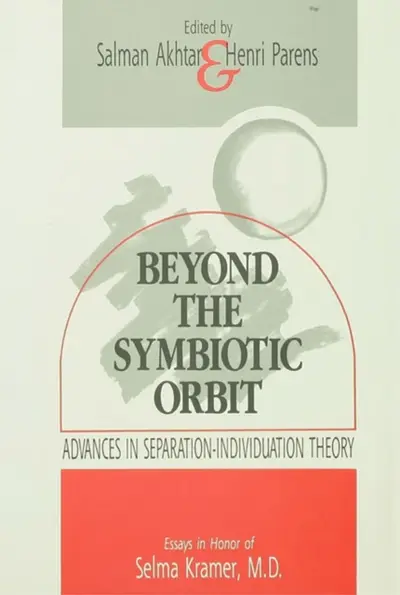
Beyond the Symbiotic Orbit
Advances in Separation-Individuation Theory: Essays in Honor of Selma Kramer, MD
Price and availability
$44.99
Available in: Andorra, Austria, Australia, Belgium, Bulgaria, Canada, Switzerland, Cyprus, Czechia, Germany, Denmark, Estonia, Spain, Finland, France, United Kingdom, Guernsey, Greece, Croatia, Hungary, Ireland, Isle of Man, Iceland, Italy, Jersey, Japan, Liechtenstein, Lithuania, Luxembourg, Latvia, Monaco, Malta, Netherlands, Norway, Poland, Portugal, Romania, Sweden, Slovenia, Slovakia, San Marino, United States, Vatican City, South Africa
Stores: US, UK, Canada, EU, Australia.
Sign in to buyThe price is re-checked by the server before payment.
For personal use under the eBook licence.
- Format
- DRM
- Not stated by the publisher
- Language
- English
- Publisher
- Taylor & Francis
- Published
- 13 May 2013
- ISBN
- 9781134881864
- Subjects
- Psychoanalytical theory (Freudian psychology), Child & developmental psychology, Social, group or collective psychology, Psychoanalytical and Freudian psychology, Child, developmental and lifespan psychology, Psychotherapy
About this book
In this tribute to Selma Kramer, eminent child analyst and colleague and close friend of the late Margaret Mahler, senior analysts explore the continuing relevance of Mahler's separation-individuation theory to developmental and clinical issues. Editors Salman Akhtar and Henri Parens have grouped the original contributions to Beyond the Symbiotic Orbit into sections that reevaluate Mahler's theory.Section I is a timely reassessment of Mahler's working model from the standpoint of contemporary clinical and research findings. It includes comparisons of Mahler with Winnicott and Kohut, and commentaries on the status of separation-individuation theory in relation to psychosexual theory, early ego development, and observational infancy research. Section II addresses the contribution of separation-individuation theory to our understanding of pathogenesis. Neurosis, severe character pathology, psychosomatic phenomena, eating disorders, and sexual perversions are among the topics of specific chapters. The final section explores the role of separation-individuation theory in the treatment of analysands of different ages and with different kinds of psychopathology; it also considers separation-individuation theory with respect to specific aspects of the treatment process, including reconstruction, transference, and termination. A fresh reappraisal of a major perspective on early development, Beyond the Symbiotic Orbit is a fitting testimonial to Selma Kramer, who has played so important a role in elaborating Mahler's theory. Following from Kramer's own example, the contributors show how separation-individuation theory, in its ability to accomodate ongoing clinical and research findings, is subject to continuing growth and refinement. They not only advance our understanding of Mahler's working model, but pursue the implications of this model in new directions, underscoring the many areas of exploration that separation-individuation theory opens to us.
Bibliographic data © Gardners Books Ltd.