PDF · English
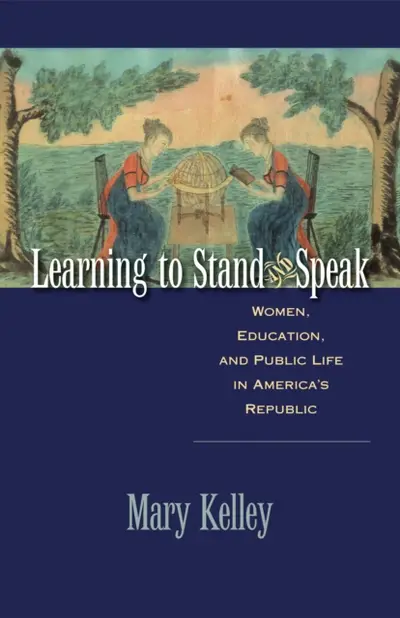
Learning to Stand and Speak
Women, Education, and Public Life in America''s Republic
Price and availability
$31.99
Available in: Andorra, Austria, Australia, Belgium, Bulgaria, Canada, Switzerland, Cyprus, Czechia, Germany, Denmark, Estonia, Spain, Finland, France, United Kingdom, Guernsey, Greece, Croatia, Hungary, Ireland, Isle of Man, Iceland, Italy, Jersey, Japan, Liechtenstein, Lithuania, Luxembourg, Latvia, Monaco, Malta, Netherlands, Norway, Poland, Portugal, Romania, Sweden, Slovenia, Slovakia, San Marino, United States, Vatican City, South Africa
Stores: US, UK, Canada, EU, Australia.
Sign in to buyThe price is re-checked by the server before payment.
For personal use under the eBook licence.
- Format
- DRM
- Not stated by the publisher
- Language
- English
- Publisher
- Omohundro Institute and UNC Press
- Published
- 1 December 2012
- ISBN
- 9798890871152
- Subjects
- USA, c 1800 to c 1900, History of the Americas, Social & cultural history, Gender studies: women, Education, United States of America, USA, Gender studies: women and girls, History of education, History of the Americas
About this book
Education was decisive in recasting womens subjectivity and the lived reality of their collective experience in post-Revolutionary and antebellum America. Asking how and why women shaped their lives anew through education, Mary Kelley measures the significant transformation in individual and social identities fostered by female academies and seminaries. Constituted in a curriculum that matched the course of study at male colleges, womens liberal learning, Kelley argues, played a key role in one of the most profound changes in gender relations in the nations history: the movement of women into public life.By the 1850s, the large majority of women deeply engaged in public life as educators, writers, editors, and reformers had been schooled at female academies and seminaries. Although most women did not enter these professions, many participated in networks of readers, literary societies, or voluntary associations that became the basis for benevolent societies, reform movements, and activism in the antebellum period. Kelleys analysis demonstrates that female academies and seminaries taught women crucial writing, oration, and reasoning skills that prepared them to claim the rights and obligations of citizenship.
Bibliographic data © Gardners Books Ltd.