EPUB · English
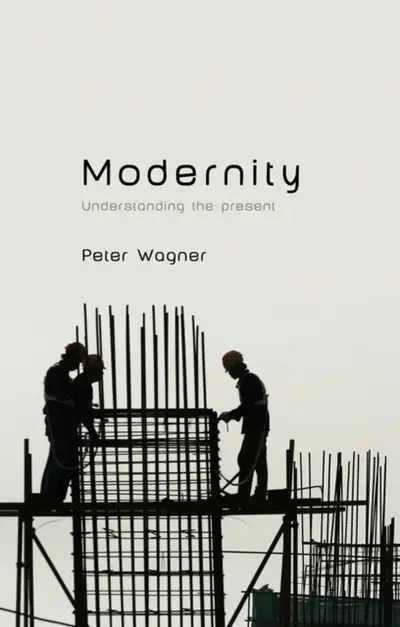
Modernity
Price and availability
$22.99
Available in: Andorra, Austria, Australia, Belgium, Bulgaria, Canada, Switzerland, Cyprus, Czechia, Germany, Denmark, Estonia, Spain, Finland, France, United Kingdom, Guernsey, Greece, Croatia, Hungary, Ireland, Isle of Man, Iceland, Italy, Jersey, Japan, Liechtenstein, Lithuania, Luxembourg, Latvia, Monaco, Malta, Netherlands, Norway, Poland, Portugal, Romania, Sweden, Slovenia, Slovakia, San Marino, United States, Vatican City, South Africa
Stores: US, UK, Canada, EU, Australia.
Sign in to buyThe price is re-checked by the server before payment.
For personal use under the eBook licence.
- Format
- EPUB
- DRM
- Not stated by the publisher
- Language
- English
- Publisher
- Polity Press
- Published
- 18 April 2013
- ISBN
- 9780745656847
- Subjects
- Sociology & anthropology, Sociology, Sociology and anthropology, Sociology
About this book
We live in a modern age, but what does modern mean and how can a reflection on modernity help us to understand the world today? These are the questions that Peter Wagner sets out to answer in this concise and accessible book. Wagner begins by returning to the question of modernity's Western origins and its claims to open up a new and better era in the history of humanity. Modernity's claims and expectations have become more prevalent and widely shared, but in the course of their realization and diffusion they have also been radically transformed. In an acute and engaging analysis, Wagner examines the following key issues among others: - Modernity was based on the hope for freedom and reason, but it created the institutions of contemporary capitalism and democracy. How does the freedom of the citizen relate to the freedom of the buyer and seller today? And what does disaffection with capitalism and democracy entail for the sustainability of modernity? - Rather than a single model of modernity, there is now a plurality of forms of modern socio-political organisation. What does this entail for our idea of progress and our hope that the future world can be better than the present one? - All nuance and broadening notwithstanding, our concept of modernity is in some way inextricably tied to the history of Europe and the West. How can we compare different forms of modernity in a 'symmetric', non-biased or non-Eurocentric way? How can we develop a world-sociology of modernity?
Bibliographic data © Gardners Books Ltd.