EPUB · English
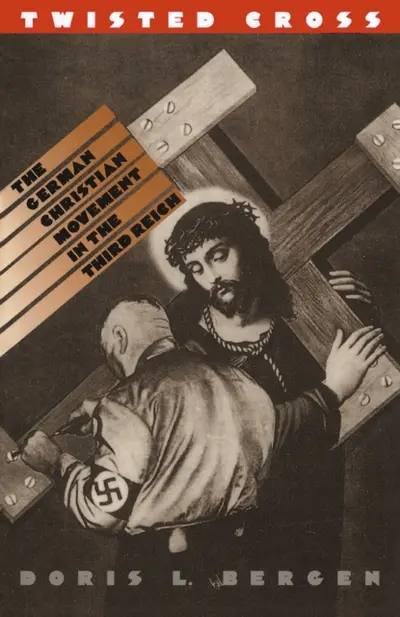
Twisted Cross
The German Christian Movement in the Third Reich
Price and availability
$40.99
Available in: Andorra, Austria, Australia, Belgium, Bulgaria, Canada, Switzerland, Cyprus, Czechia, Germany, Denmark, Estonia, Spain, Finland, France, United Kingdom, Guernsey, Greece, Croatia, Hungary, Ireland, Isle of Man, Iceland, Italy, Jersey, Japan, Liechtenstein, Lithuania, Luxembourg, Latvia, Monaco, Malta, Netherlands, Norway, Poland, Portugal, Romania, Sweden, Slovenia, Slovakia, San Marino, United States, Vatican City, South Africa
Stores: US, UK, Canada, EU, Australia.
Sign in to buyThe price is re-checked by the server before payment.
For personal use under the eBook licence.
- Format
- EPUB
- DRM
- Not stated by the publisher
- Language
- English
- Publisher
- The University of North Carolina Press
- Published
- 9 November 2000
- ISBN
- 9780807860342
- Subjects
- Germany, European history, 20th century history: c 1900 to c 2000, Christian theology, Fascism & Nazism, Germany, European history
About this book
How did Germanys Christians respond to Nazism? In Twisted Cross, Doris Bergen addresses one important element of this response by focusing on the 600,000 self-described 'German Christians,' who sought to expunge all Jewish elements from the Christian church. In a process that became more daring as Nazi plans for genocide unfolded, this group of Protestant lay people and clergy rejected the Old Testament, ousted people defined as non-Aryans from their congregations, denied the Jewish ancestry of Jesus, and removed Hebrew words like 'Hallelujah' from hymns. Bergen refutes the notion that the German Christians were a marginal group and demonstrates that members occupied key positions within the Protestant church even after their agenda was rejected by the Nazi leadership. Extending her analysis into the postwar period, Bergen shows how the German Christians were relatively easily reincorporated into mainstream church life after 1945. Throughout Twisted Cross, Bergen reveals the important role played by women and by the ideology of spiritual motherhood amid the German Christians' glorification of a 'manly' church.
Bibliographic data © Gardners Books Ltd.