PDF · English
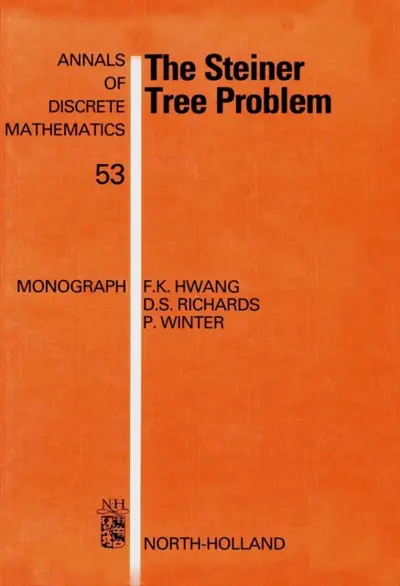
Steiner Tree Problem
Price and availability
$59.99
Available in: Andorra, Austria, Australia, Belgium, Bulgaria, Canada, Switzerland, Cyprus, Czechia, Germany, Denmark, Estonia, Spain, Finland, France, United Kingdom, Guernsey, Greece, Croatia, Hungary, Ireland, Isle of Man, Iceland, Italy, Jersey, Japan, Liechtenstein, Lithuania, Luxembourg, Latvia, Monaco, Malta, Netherlands, Norway, Poland, Portugal, Romania, Sweden, Slovenia, Slovakia, San Marino, United States, Vatican City, South Africa
Stores: US, UK, Canada, EU, Australia.
Sign in to buyThe price is re-checked by the server before payment.
For personal use under the eBook licence.
- Format
- DRM
- Not stated by the publisher
- Language
- English
- Publisher
- Elsevier Science
- Published
- 20 October 1992
- ISBN
- 9780080867939
- Subjects
- Discrete mathematics, Computer architecture & logic design, Discrete mathematics, Computer architecture and logic design
About this book
The Steiner problem asks for a shortest network which spans a given set of points. Minimum spanning networks have been well-studied when all connections are required to be between the given points. The novelty of the Steiner tree problem is that new auxiliary points can be introduced between the original points so that a spanning network of all the points will be shorter than otherwise possible. These new points are called Steiner points - locating them has proved problematic and research has diverged along many different avenues.This volume is devoted to the assimilation of the rich field of intriguing analyses and the consolidation of the fragments. A section has been given to each of the three major areas of interest which have emerged. The first concerns the Euclidean Steiner Problem, historically the original Steiner tree problem proposed by Jarnik and Kossler in 1934. The second deals with the Steiner Problem in Networks, which was propounded independently by Hakimi and Levin and has enjoyed the most prolific research amongst the three areas. The Rectilinear Steiner Problem, introduced by Hanan in 1965, is discussed in the third part. Additionally, a forth section has been included, with chapters discussing areas where the body of results is still emerging.The collaboration of three authors with different styles and outlooks affords individual insights within a cohesive whole.
Bibliographic data © Gardners Books Ltd.