PDF · English
Post-Conflict Power-Sharing Agreements
Options for Syria
Price and availability
$120.99
Available in: Andorra, Austria, Australia, Belgium, Bulgaria, Canada, Switzerland, Cyprus, Czechia, Germany, Denmark, Estonia, Spain, Finland, France, United Kingdom, Guernsey, Greece, Croatia, Hungary, Ireland, Isle of Man, Iceland, Italy, Jersey, Japan, Liechtenstein, Lithuania, Luxembourg, Latvia, Monaco, Malta, Netherlands, Norway, Poland, Portugal, Romania, Sweden, Slovenia, Slovakia, San Marino, United States, Vatican City, South Africa
Stores: US, UK, Canada, EU, Australia.
Sign in to buyThe price is re-checked by the server before payment.
For personal use under the eBook licence.
- Format
- DRM
- Not stated by the publisher
- Language
- English
- Publisher
- Springer International Publishing
- Published
- 27 July 2017
- ISBN
- 9783319601045
- Subjects
- Middle East, Development studies, Peace studies & conflict resolution, Political structure & processes, International relations, Middle East, Peace studies and conflict resolution, Politics and government, Central / national / federal government, International relations
About this book
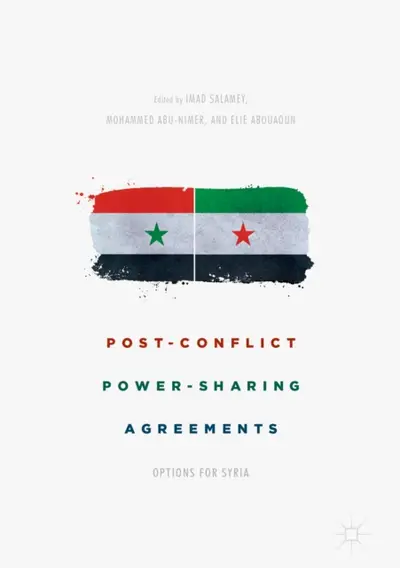
The book surveys comparative power sharing models implemented in societies that have faced identity-conflicts, with attention given to post-conflict design. It analyzes the success and pitfalls of international experiences before proposing a model for Syria. Contributors address the central question: which among the set of power-sharing agreements that have helped settle protracted identity-driven armed conflict can provide Syria with a platform for dialogue, negotiation, and conflict mitigation? The comparative analysis advanced in this book extracts lessons from countries such as Bosnia-Herzegovina, India, Iraq, Lebanon, Mali, Northern Ireland, the Philippines and Sudan. The prospect of a post-conflict distribution of power in Syria is then unraveled from different sectarian, ethnic and regional perspectives. The authors also address challenges of peacebuilding such as violent extremism, gender participation, resettlements, retributions, transitional justice, integration of armed groups and regional and international sponsorship.
Bibliographic data © Gardners Books Ltd.