PDF · English
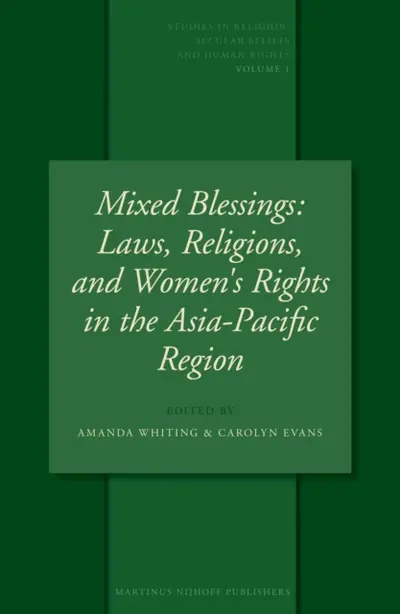
Mixed Blessings
Laws, Religions, and Women's Rights in the Asia-Pacific Region
Price and availability
$314.99
Available in: Andorra, Austria, Australia, Belgium, Bulgaria, Canada, Switzerland, Cyprus, Czechia, Germany, Denmark, Estonia, Spain, Finland, France, United Kingdom, Guernsey, Greece, Croatia, Hungary, Ireland, Isle of Man, Iceland, Italy, Jersey, Japan, Liechtenstein, Lithuania, Luxembourg, Latvia, Monaco, Malta, Netherlands, Norway, Poland, Portugal, Romania, Sweden, Slovenia, Slovakia, San Marino, United States, Vatican City, South Africa
Stores: US, UK, Canada, EU, Australia.
Sign in to buyThe price is re-checked by the server before payment.
For personal use under the eBook licence.
- Format
- DRM
- Not stated by the publisher
- Language
- English
- Publisher
- Brill
- Published
- 1 May 2006
- ISBN
- 9789047409656
- Subjects
- Religion: general, Philosophy of religion, Spirituality & religious experience, Gender studies: women, Human rights, International law, Constitutional & administrative law, Public international law: human rights, Religion: general, Alternative belief systems and spiritual worldviews
About this book
The essays in this volume explore some of the diverse and contradictory ways that the lives of women in the Asia-Pacific region are shaped by two powerful regimes - 'religion' and 'law' - and by the interactions between them. They show that for women, laws - customary, colonial, post-independence and international - and religions - indigenous or introduced, Buddhism, Christianity, Islam and Confucianism - have been a 'mixed blessing'. These diverse legal systems and religious doctrines and institutions have variously denied women authority and the capacity to participate fully in the public organization of social, political and religious life; they have furthermore constructed gender and familial relations in ways that subordinate women. Yet they have also offered promises of women's empowerment, and provided rules and procedures, norms, values, and interpretations of sacred traditions to deliver those empancipatory promises. Each chapter is devoted to a single state; first, the history and current framework of the national legal system is introduced; then the place of religion in the state is explained; and finally, by means of precise and detailed case studies or examples, each author explores how these sometimes competing, sometimes colluding regimes constructed women and how women interpreted this positioning and sought to resituate themselves.
Bibliographic data © Gardners Books Ltd.