PDF · English
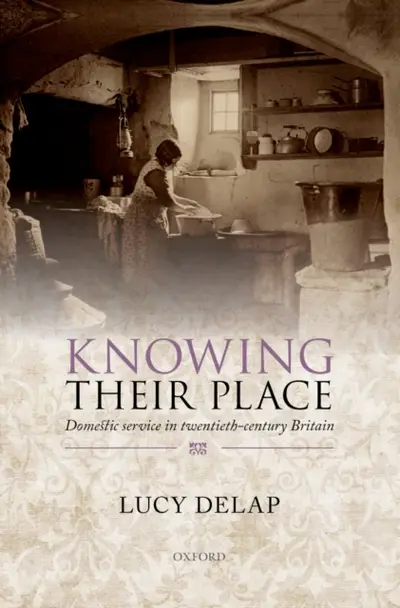
Knowing Their Place
Domestic service in twentieth-century Britain
Price and availability
$35.99
Available in: Andorra, Austria, Australia, Belgium, Bulgaria, Canada, Switzerland, Cyprus, Czechia, Germany, Denmark, Estonia, Spain, Finland, France, United Kingdom, Guernsey, Greece, Croatia, Hungary, Ireland, Isle of Man, Iceland, Italy, Jersey, Japan, Liechtenstein, Lithuania, Luxembourg, Latvia, Monaco, Malta, Netherlands, Norway, Poland, Portugal, Romania, Sweden, Slovenia, Slovakia, San Marino, United States, Vatican City, South Africa
Stores: US, UK, Canada, EU, Australia.
Sign in to buyThe price is re-checked by the server before payment.
For personal use under the eBook licence.
- Format
- DRM
- Not stated by the publisher
- Language
- English
- Publisher
- OUP Oxford
- Published
- 16 June 2011
- ISBN
- 9780191618222
- Subjects
- United Kingdom, Great Britain, 20th century, British & Irish history, 20th century history: c 1900 to c 2000, Social & cultural history, Gender studies: women, Sociology: work & labour, Gender studies: women and girls, European history, Social and cultural history
About this book
Historians have traditionally seen domestic service as an obsolete or redundant sector from the middle of the twentieth century. Knowing Their Place challenges this by linking the early twentieth-century employment of maids and cooks to later practices of employing au pairs, mothers' helps, and cleaners. Lucy Delap tells the story of lives and labour within British homes, from great houses to suburbs and slums, and charts the interactions of servants and employers along with the intense controversies and emotions they inspired. Knowing Their Place also examines the employment of men and migrant workers, as well as the role of laughter and erotic desire in shaping domestic service. The memory of domestic service and the role of the past in shaping and mediating the present is examined through heritage and televisual sources, from Upstairs, Downstairs to The 1900 House. Drawing from advice manuals, magazines, novels, cinema, memoirs, feminist tracts, and photographs, this fascinating book points to new directions in cultural history through its engagement in innovative areas such as the history of emotions and cultural memory. Through its attention to the contemporary rise in the employment of domestic workers, Knowing Their Place sets modern Britain in a new and compelling historical context.
Bibliographic data © Gardners Books Ltd.