PDF · English
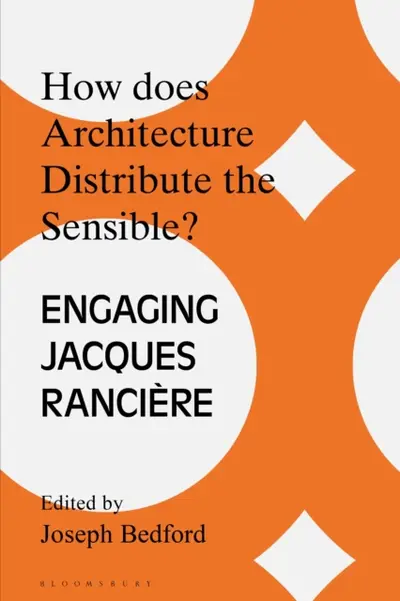
How Does Architecture Distribute the Sensible?
Engaging Jacques Ranci re
Price and availability
$103.99
Available in: Andorra, Austria, Australia, Belgium, Bulgaria, Canada, Switzerland, Cyprus, Czechia, Germany, Denmark, Estonia, Spain, Finland, France, United Kingdom, Guernsey, Greece, Croatia, Hungary, Ireland, Isle of Man, Iceland, Italy, Jersey, Japan, Liechtenstein, Lithuania, Luxembourg, Latvia, Monaco, Malta, Netherlands, Norway, Poland, Portugal, Romania, Sweden, Slovenia, Slovakia, San Marino, United States, Vatican City, South Africa
Stores: US, UK, Canada, EU, Australia.
Sign in to buyThe price is re-checked by the server before payment.
For personal use under the eBook licence.
- Format
- DRM
- Not stated by the publisher
- Language
- English
- Publisher
- Bloomsbury Publishing
- Published
- 13 November 2025
- Pages
- 208
- ISBN
- 9781350342811
- Subjects
- Theory of architecture, Philosophy: aesthetics, Theory of architecture, QDTN
About this book
Jacques Ranci re is one of the leading thinkers not only of contemporary aesthetic theory but contemporary philosophy in general. After his break from Althusser, Ranci re developed the radical and axiomatic principal of the absolute equality of intelligences and capacities that defined his entire body of work, from his critique of philosophy, to his historical studies of emancipated modes of labor and education, to the articulation of dissensus from the order of the police. Ranci re's trajectory as a philosopher led him towards aesthetics where offered a radical reinterpretation of the political meaning of aesthetics and with it, of modernism and postmodernism that, having shaken the world of art, is now shaking the world of architecture. This book brings Jacques Ranci re's demand for equality and his reformulation of aesthetics into direct dialogue with architecture. In doing so, it inquires into the role that architecture plays in distributing the sensible, in creating aesthetic experiences, in creating order or dissensus, in serving as a mode of critique, and in emancipating or stultifying its users and subjects. Through this detailed exchange between Ranci re and four of the world's leading architectural thinkers; Anthony Vidler, Joan Ockman, Peggy Deamer and Michael Young, a debate unfolds within the book that tests the implications of Ranci re's aesthetic philosophy for architectural practice today; questioning the way we write architectural history, how architects draw, what the labor of the architect is, and that questions key architectural ideas such as the distribution, function, use, ornament, discipline and design.
Bibliographic data © Gardners Books Ltd.