EPUB · English
Family Systems Test (FAST)
Theory and Application
Price and availability
$67.99
Available in: Andorra, Austria, Australia, Belgium, Bulgaria, Canada, Switzerland, Cyprus, Czechia, Germany, Denmark, Estonia, Spain, Finland, France, United Kingdom, Guernsey, Greece, Croatia, Hungary, Ireland, Isle of Man, Iceland, Italy, Jersey, Japan, Liechtenstein, Lithuania, Luxembourg, Latvia, Monaco, Malta, Netherlands, Norway, Poland, Portugal, Romania, Sweden, Slovenia, Slovakia, San Marino, United States, Vatican City, South Africa
Stores: US, UK, Canada, EU, Australia.
Sign in to buyThe price is re-checked by the server before payment.
For personal use under the eBook licence.
- Format
- EPUB
- DRM
- Not stated by the publisher
- Language
- English
- Publisher
- Taylor & Francis
- Published
- 1 February 2013
- ISBN
- 9781134693771
- Subjects
- Sociology: family & relationships, Psychology, Psychological testing & measurement, Family psychology, Social, group or collective psychology, Clinical psychology, Psychotherapy, Research methods / methodology, Psychological testing and measurement, Couple and Family psychology
About this book
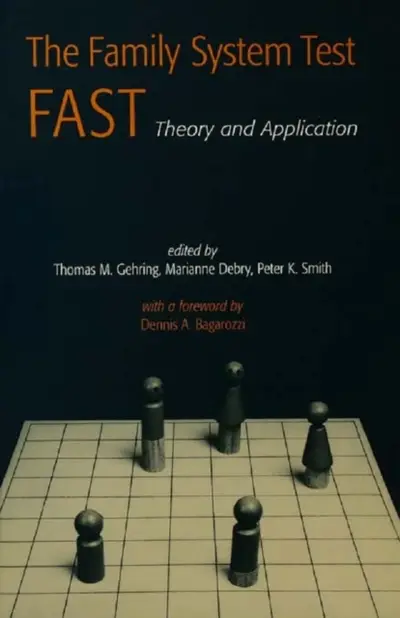
The Family System Test (FAST), developed by Thomas M. Gehring, is an important new tool for investigating family relations. Based on the structural-systemic theory of families, it is a figural technique for representing emotional bonds (cohesion) and hierarchical structures in the family or similar social systems. In this unique volume, the editors draw on current theory and research in family or similar social systems together with a variety of empirical studies that have used the FAST, to provide a comprehensive overview and assessment of the test and its use in various clinical research contexts.The book is divided into four sections, each focusing on a different aspect of the FAST. Part 1 describes the concepts and psychometric properties of the FAST within the context of theoretically and empirically relevant aspects of the field of family psychology as a whole. Special emphasis is given to systematic-structural approaches to assessing individual and family functioning. Part II focuses on the use of the FAST in developmental research. For example, the the FAST has been used to show how family constructs are influenced by age, type of family and situation. Part III deals with cross-cultural issues and compares the interpersonal constructs of Japanese and Chinese families to Western families. Finally, Part IV addresses the applications of the FAST in clinical setting - in diagnosis of biopsychosocial problems and planning and evaluation of clinical interventions.The result is a book that helps to bridge the gap between theory, practice and research. It will be essential reading for users of the FAST and all clinicians and researchers who work in family relations and development.
Bibliographic data © Gardners Books Ltd.