PDF · English
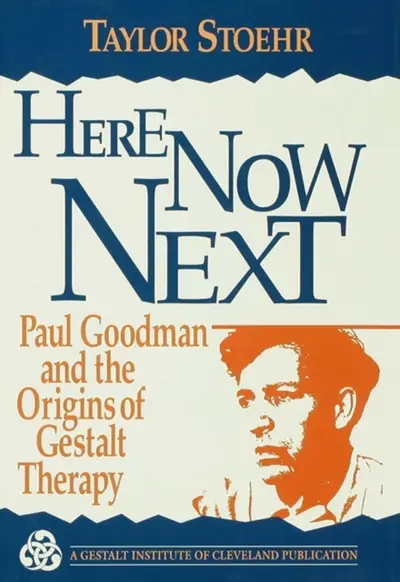
Here Now Next
Paul Goodman and the Origins of Gestalt Therapy
Price and availability
$62.99
Available in: Andorra, Austria, Australia, Belgium, Bulgaria, Canada, Switzerland, Cyprus, Czechia, Germany, Denmark, Estonia, Spain, Finland, France, United Kingdom, Guernsey, Greece, Croatia, Hungary, Ireland, Isle of Man, Iceland, Italy, Jersey, Japan, Liechtenstein, Lithuania, Luxembourg, Latvia, Monaco, Malta, Netherlands, Norway, Poland, Portugal, Romania, Sweden, Slovenia, Slovakia, San Marino, United States, Vatican City, South Africa
Stores: US, UK, Canada, EU, Australia.
Sign in to buyThe price is re-checked by the server before payment.
For personal use under the eBook licence.
- Format
- DRM
- Not stated by the publisher
- Language
- English
- Publisher
- Taylor & Francis
- Published
- 13 May 2013
- ISBN
- 9781134898381
- Subjects
- Biography: general, Psychology, Social, group or collective psychology, Psychotherapy, Psychoanalytical and Freudian psychology, Psychotherapy
About this book
Paul Goodman left his mark in a number of fields: he went from being known as a social critic and philosopher of the New Left to poet and literary critic to author of influential works on education (Compulsory Mis-education) and community planning (Communitas). Perhaps his most significant achievement was in his contribution to the founding and theoretical portion of the classic text Gestalt Therapy (with F. S. Perls and R. E. Hefferline, 1951), still regarded as the cornerstone of Gestalt practice.Taylor Stoher's Here Now Next is the first scholarly account of the origins of Gestalt therapy, told from the point of view of its chief theoretician by a man who knew him well. Stoehr describes both Goodman's role in establishing the principal ideas of the Gestalt movement and the ways in which his practice as a therapist changed him, ultimately leading to a new vocation as the "e;socio-therapist"e; of the body politic. He places Goodman in the midst of his world, showing how his personal and public life - including his political activities in the 1960s - were transformed by Gestalt ideas, and he presents revealing sketches of other major figures from those days - Fritz Perls, Wilhelm Reich, A. S. Neill, and others.
Bibliographic data © Gardners Books Ltd.