PDF · English
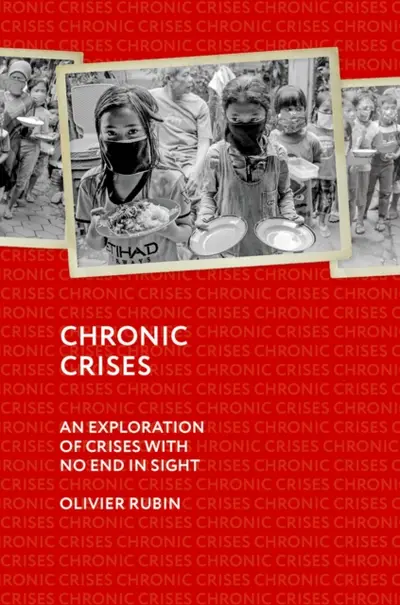
Chronic Crises
An Exploration of Crises with No End in Sight
Price and availability
$72.99
Available in: Andorra, Austria, Australia, Belgium, Bulgaria, Canada, Switzerland, Cyprus, Czechia, Germany, Denmark, Estonia, Spain, Finland, France, United Kingdom, Guernsey, Greece, Croatia, Hungary, Ireland, Isle of Man, Iceland, Italy, Jersey, Japan, Liechtenstein, Lithuania, Luxembourg, Latvia, Monaco, Malta, Netherlands, Norway, Poland, Portugal, Romania, Sweden, Slovenia, Slovakia, San Marino, United States, Vatican City, South Africa
Stores: US, UK, Canada, EU, Australia.
Sign in to buyThe price is re-checked by the server before payment.
For personal use under the eBook licence.
- Format
- DRM
- Not stated by the publisher
- Language
- English
- Publisher
- Oxford University Press
- Published
- 19 May 2026
- ISBN
- 9780197786451
- Subjects
- Social impact of disasters, Illness & addiction: social aspects, Public health & preventive medicine, Personal & public health, JBFF, JBFN, Public health and preventive medicine, Personal and public health / health education
About this book
Recent years have made apparent we are living in a world of chronic crises: prolonged disasters that continue to impact people's lives long after their onset. Climate change, famine, and the COVID-19 pandemic represent a few of these disasters--instead of a return to "e;an accepted state of normalcy"e; in their wake, the ramifications continue to reverberate around the world. In Chronic Crises, Olivier Rubin examines what happens, socially and politically, when the end life of a disaster is characterized by a perpetual state of crisis dynamics. He identifies three distinct types of chronic crisis: seething chronic crises, such as famine and multiple starvation deaths; perpetual chronic crises, including antimicrobial resistance and climate change; and transitional chronic crises, exemplified by COVID-19 and HIV/AIDS. Rubin describes the nature of each category, including the underlying temporal dynamics, the disparate impacts in different parts of the globe and different social groups, and how communities adjust to the crises. He then analyzes the politics, investigating how the different features of the crisis types influence policymakers' attention and response, their ability and incentives to put chronic crises on the political agenda, and the prospects for implementing effective policies. Looking to the future, Rubin provides policy recommendations and practical advice for crisis management dealing with chronic crises moving forward.
Bibliographic data © Gardners Books Ltd.