PDF · English
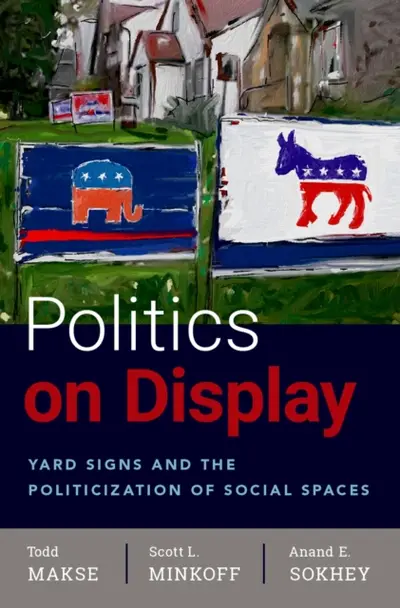
Politics on Display
Yard Signs and the Politicization of Social Spaces
Price and availability
$31.99
Available in: Andorra, Austria, Australia, Belgium, Bulgaria, Canada, Switzerland, Cyprus, Czechia, Germany, Denmark, Estonia, Spain, Finland, France, United Kingdom, Guernsey, Greece, Croatia, Hungary, Ireland, Isle of Man, Iceland, Italy, Jersey, Japan, Liechtenstein, Lithuania, Luxembourg, Latvia, Monaco, Malta, Netherlands, Norway, Poland, Portugal, Romania, Sweden, Slovenia, Slovakia, San Marino, United States, Vatican City, South Africa
Stores: US, UK, Canada, EU, Australia.
Sign in to buyThe price is re-checked by the server before payment.
For personal use under the eBook licence.
- Format
- DRM
- Not stated by the publisher
- Language
- English
- Publisher
- Oxford University Press
- Published
- 5 April 2019
- ISBN
- 9780190926335
- Subjects
- Elections & referenda, Diplomacy, Elections and referenda / suffrage, Diplomacy
About this book
Political yard signs are one of the most ubiquitous and conspicuous features of American political campaigns, yet they have received relatively little attention as a form of political communication or participation. In Politics on Display, Todd Makse, Scott L. Minkoff, and Anand E. Sokhey tackle this phenomenon to craft a larger argument about the politics of identity and space in contemporary America. Documenting political life in two suburban communities and a major metropolitan area, they use an unprecedented research design that leverages street-level observation of the placement of yard signs and neighborhood-specific survey research that delves into the attitudes, behavior, and social networks of residents. The authors then integrate these data into a geo-database that also includes demographic and election data. Supplemented by nationally-representative data sources, the book brings together insights from political communication, political psychology, and political geography. Against a backdrop of conflict and division, this book advances a new understanding of how citizens experience campaigns, why many still insist on airing their views in public, and what happens when social spaces become political spaces.
Bibliographic data © Gardners Books Ltd.