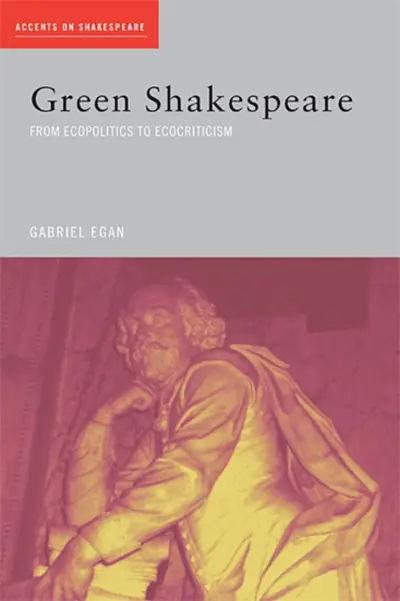
EPUB · English
Green Shakespeare
From Ecopolitics to Ecocriticism
Price and availability
$59.99
Available in: Andorra, Austria, Australia, Belgium, Bulgaria, Canada, Switzerland, Cyprus, Czechia, Germany, Denmark, Estonia, Spain, Finland, France, United Kingdom, Guernsey, Greece, Croatia, Hungary, Ireland, Isle of Man, Iceland, Italy, Jersey, Japan, Liechtenstein, Lithuania, Luxembourg, Latvia, Monaco, Malta, Netherlands, Norway, Poland, Portugal, Romania, Sweden, Slovenia, Slovakia, San Marino, United States, Vatican City, South Africa
Stores: US, UK, Canada, EU, Australia.
Sign in to buyThe price is re-checked by the server before payment.
For personal use under the eBook licence.
- Format
- EPUB
- DRM
- Not stated by the publisher
- Language
- English
- Publisher
- Taylor & Francis
- Published
- 27 September 2006
- ISBN
- 9781134351220
- Subjects
- Literature: history & criticism, Literary studies: plays and playwrights, Cultural studies, Environmental policy and protocols
About this book
Ecocriticism, a theoretical movement examining cultural constructions of Nature in their social and political contexts, is making an increasingly important contribution to our understanding of Shakespeare's plays. Gabriel Egan's Green Shakespeare presents: an overview of the concept of ecocriticism detailed ecocritical readings of Henry V, Macbeth, As You Like It, Antony & Cleopatra, King Lear, Coriolanus, Pericles, Cymbeline, The Winter's Tale and The Tempest analysis of themes such as nature and human society; food and biological nature; the supernatural and the weather a bold argument for a contemporary 'EcoShakespeare', taking into account the environmental and political implications of globalization and intellectual property laws. Crossing the boundaries of literary and cultural studies to draw in politics, philosophy and ecology, this volume not only introduces one of the most lively areas of contemporary Shakespeare studies, but also puts forward a convincing case for Shakespeare's continuing relevance to contemporary theory.
Bibliographic data © Gardners Books Ltd.