EPUB · English
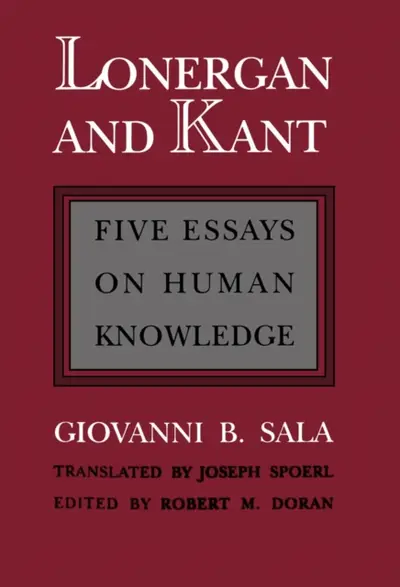
Lonergan and Kant
Price and availability
$35.99
Available in: Andorra, Austria, Australia, Belgium, Bulgaria, Canada, Switzerland, Cyprus, Czechia, Germany, Denmark, Estonia, Spain, Finland, France, United Kingdom, Guernsey, Greece, Croatia, Hungary, Ireland, Isle of Man, Iceland, Italy, Jersey, Japan, Liechtenstein, Lithuania, Luxembourg, Latvia, Monaco, Malta, Netherlands, Norway, Poland, Portugal, Romania, Sweden, Slovenia, Slovakia, San Marino, United States, Vatican City, South Africa
Stores: US, UK, Canada, EU, Australia.
Sign in to buyThe price is re-checked by the server before payment.
For personal use under the eBook licence.
- Format
- EPUB
- DRM
- Not stated by the publisher
- Language
- English
- Publisher
- University of Toronto Press
- Published
- 27 July 2015
- Pages
- 196
- ISBN
- 9781487510541
- Subjects
- Humanities, Philosophy, History of Western philosophy, Philosophy: epistemology & theory of knowledge, Popular philosophy, Philosophy of religion, History of ideas, JBCC9, NH, QD, QDH, QDTK, QDX, QRAB
About this book
Lonergan's Insight has frequently been compared with Kant's Critique of Pure Reason. Giovanni B. Sala, an internationally acknowledged Kant scholar, contrasts the cognitional theory of his former teacher Lonergan with the positions of Kant that have proved so influential, and in many ways so intractable, over the past two centuries.The first essay is one of the most influential papers ever written on Lonergan; it and the second one inquire into the notion of the a priori. The third essay presents a detailed analysis of Kantian intuitionism and contrasts it with the `knowledge as structure' position of Lonergan's critical realism. In this essay intuitionism is generalized, to allow Sala to address representatives of neoscholasticism as well. The argument with neoscholasticism continues in the fourth essay. The final paper discusses Kant's resolution of the question regarding the agreement of a priori concepts with things, and finds in Lonergan's work an alternative position on correspondence and truth. Each essay is a model of careful and thorough scholarship, and also - surprising in a book of such proportions - of clarity. Lonergan appeals several times in Insight to the device of `Clarification by Contrast.' Sala's essays show us in intricate detail how illuminating such comparisons can be.
Bibliographic data © Gardners Books Ltd.