PDF · English
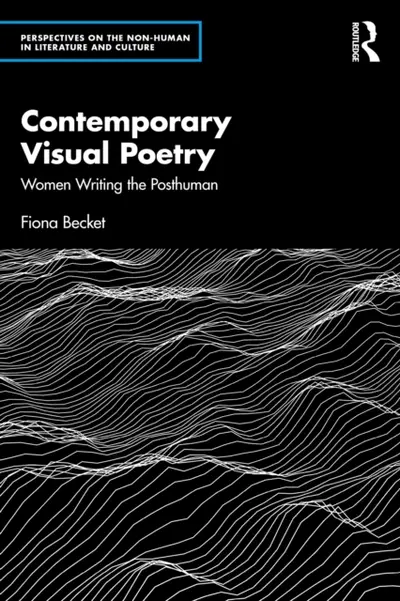
Contemporary Visual Poetry
Women Writing the Posthuman
Price and availability
$64.99
Available in: Andorra, Austria, Australia, Belgium, Bulgaria, Canada, Switzerland, Cyprus, Czechia, Germany, Denmark, Estonia, Spain, Finland, France, United Kingdom, Guernsey, Greece, Croatia, Hungary, Ireland, Isle of Man, Iceland, Italy, Jersey, Japan, Liechtenstein, Lithuania, Luxembourg, Latvia, Monaco, Malta, Netherlands, Norway, Poland, Portugal, Romania, Sweden, Slovenia, Slovakia, San Marino, United States, Vatican City, South Africa
Stores: US, UK, Canada, EU, Australia.
Sign in to buyThe price is re-checked by the server before payment.
For personal use under the eBook licence.
- Format
- DRM
- Not stated by the publisher
- Language
- English
- Publisher
- Taylor & Francis
- Published
- 15 September 2025
- ISBN
- 9781040308356
- Subjects
- The arts: general issues, Literary studies: from c 1900 -, Literary studies: poetry & poets, Feminism & feminist theory, Literary studies: poetry and poets, Feminism and feminist theory, Digital Humanities / Computer applications in the arts and humanities
About this book
This book examines contemporary visual poetry and how conceptual writing, poem-objects, and computational texts shape a posthumanist understanding that is "e;situated"e;. First, the eye is theorised with respect to ethical understanding. When visual poets reclaim vision, visual poetics becomes a feminist praxis. In Paula Claire and Maggie O'Sullivan, visual poetry becomes an ecological practice concerned with connectivity in the entanglements of natureculture. In O'Sullivan, Campanello, Bergvall, and Philip, spatial and temporal sense (de)formation sustains radical forms of voicing and eyewitness. Finally, works by Mez Breeze and Stephanie Strickland expand our understanding of visual poetry in digital (electronic, virtual reality, and artificial intelligence) contexts in which technology and affect are intimately connected. These visual texts open up Braidotti's question with respect to how we are to "e;visualize the subject as a transversal entity encompassing the human, our genetic neighbours the animals and the earth as a whole, and to do so within an understandable language"e;.
Bibliographic data © Gardners Books Ltd.