PDF · English
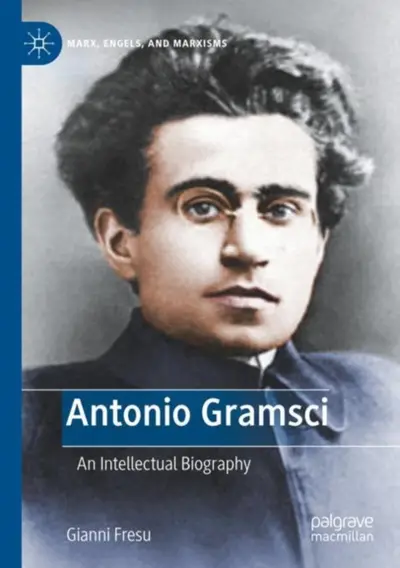
Antonio Gramsci
An Intellectual Biography
Price and availability
$47.99
Available in: Andorra, Austria, Australia, Belgium, Bulgaria, Canada, Switzerland, Cyprus, Czechia, Germany, Denmark, Estonia, Spain, Finland, France, United Kingdom, Guernsey, Greece, Croatia, Hungary, Ireland, Isle of Man, Iceland, Italy, Jersey, Japan, Liechtenstein, Lithuania, Luxembourg, Latvia, Monaco, Malta, Netherlands, Norway, Poland, Portugal, Romania, Sweden, Slovenia, Slovakia, San Marino, United States, Vatican City, South Africa
Stores: US, UK, Canada, EU, Australia.
Sign in to buyThe price is re-checked by the server before payment.
For personal use under the eBook licence.
- Format
- DRM
- Not stated by the publisher
- Language
- English
- Publisher
- Springer International Publishing
- Published
- 31 October 2022
- ISBN
- 9783031156106
- Subjects
- Italy, History, European history, Social & political philosophy, Political science & theory, Italy, History of ideas, Political science and theory, European history, Social and political philosophy
About this book
This intellectual biography provides an organic framework for understanding Antonio Gramsci's process of intellectual development, paying close attention to the historical and intellectual contexts out of which his views emerged. The Gramsci in Notebooks cannot fully account for the young director of L'Ordine Nuovo, or for the communist leader. Gramsci's development did not occur under conditions of intellectual inflexibility, of absence of evolution. However, there is a strong thread connecting the "e;political Gramsci"e; with Gramsci as a "e;cultivated man."e; The Sardinian intellectual's life is marked by the drama of World War I, the first mass conflict in which the great scientific discoveries of the previous decades were applied on a large scale and in which millions of peasants and workers were slaughtered. In all of his theoretical formulations, this dual relation, which epitomizes the instrumental use of "e;simpletons"e; by ruling classes, goes beyond the military context of the trenches and becomes full-fledged in the fundamental relations of modern capitalist society. In contrast with this notion of social hierarchy, which is deemed natural and unchangeable, Gramsci constantly affirmed the need to overcome the historically determined rupture between intellectual and manual functions, due to which the existence of a priesthood or of a separate caste of specialists in politics and in knowledge is made necessary. It is not the specific professional activity (whether material or immaterial) that determines the essence of human nature: to Gramsci, "e;all men are philosophers."e; In this passage from Notebooks, we find the condensed form of his idea of "e;human emancipation,"e; which is the historical need for an "e;intellectual and moral reform"e;: the subversion of traditional relations between rulers and ruled and the end of exploitation of man by man.
Bibliographic data © Gardners Books Ltd.