EPUB · English
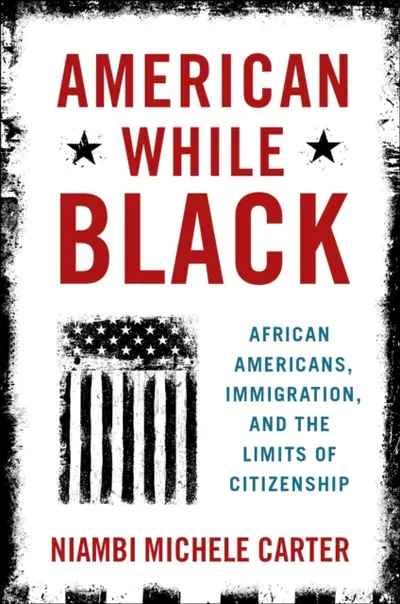
American While Black
African Americans, Immigration, and the Limits of Citizenship
Price and availability
$29.99
Available in: Andorra, Austria, Australia, Belgium, Bulgaria, Canada, Switzerland, Cyprus, Czechia, Germany, Denmark, Estonia, Spain, Finland, France, United Kingdom, Guernsey, Greece, Croatia, Hungary, Ireland, Isle of Man, Iceland, Italy, Jersey, Japan, Liechtenstein, Lithuania, Luxembourg, Latvia, Monaco, Malta, Netherlands, Norway, Poland, Portugal, Romania, Sweden, Slovenia, Slovakia, San Marino, United States, Vatican City, South Africa
Stores: US, UK, Canada, EU, Australia.
Sign in to buyThe price is re-checked by the server before payment.
For personal use under the eBook licence.
- Format
- EPUB
- DRM
- Not stated by the publisher
- Language
- English
- Publisher
- Oxford University Press
- Published
- 15 August 2019
- ISBN
- 9780190053574
- Subjects
- Migration, immigration & emigration, Ethnic studies, Comparative politics, Public opinion & polls, JBFH, JBSL, Comparative politics, JPWA
About this book
At the same time that the Civil Rights Movement brought increasing opportunities for blacks, the United States liberalized its immigration policy. While the broadening of the United States's borders to non-European immigrants fits with a black political agenda of social justice, recent waves of immigration have presented a dilemma for blacks, prompting ambivalent or even negative attitudes toward migrants. What has an expanded immigration regime meant for how blacks express national attachment? In this book, Niambi Michele Carter argues that immigration, both historically and in the contemporary moment, has served as a reminder of the limited inclusion of African Americans in the body politic. As Carter contends, blacks use the issue of immigration as a way to understand the nature and meaning of their American citizenship-specifically the way that white supremacy structures and constrains not just their place in the American political landscape, but their political opinions as well. White supremacy gaslights black people, and others, into critiquing themselves and each other instead of white supremacy itself. But what may appear to be a conflict between blacks and other minorities is about self-preservation. Carter draws on original interview material and empirical data on African American political opinion to offer the first theory of black public opinion toward immigration.
Bibliographic data © Gardners Books Ltd.