PDF · English
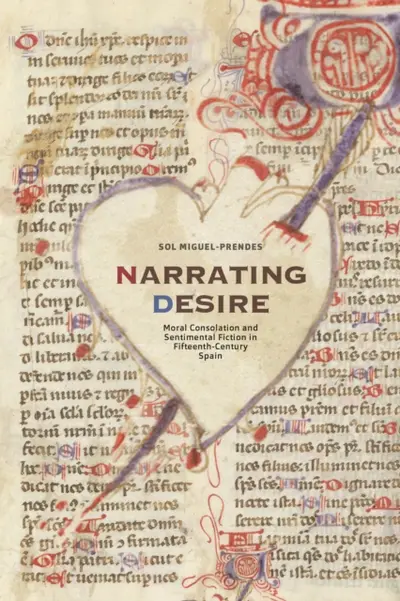
Narrating Desire
Moral Consolation and Sentimental Fiction in Fifteenth-Century Spain
Price and availability
$40.99
Available in: Andorra, Austria, Australia, Belgium, Bulgaria, Canada, Switzerland, Cyprus, Czechia, Germany, Denmark, Estonia, Spain, Finland, France, United Kingdom, Guernsey, Greece, Croatia, Hungary, Ireland, Isle of Man, Iceland, Italy, Jersey, Japan, Liechtenstein, Lithuania, Luxembourg, Latvia, Monaco, Malta, Netherlands, Norway, Poland, Portugal, Romania, Sweden, Slovenia, Slovakia, San Marino, United States, Vatican City, South Africa
Stores: US, UK, Canada, EU, Australia.
Sign in to buyThe price is re-checked by the server before payment.
For personal use under the eBook licence.
- Format
- DRM
- Not stated by the publisher
- Language
- English
- Publisher
- UNC Department of Romance Studies
- Published
- 15 November 2019
- ISBN
- 9798890858788
- Subjects
- Southern Europe, Spain, c 1000 CE to c 1500, Literary studies: general, Literary studies: classical, early & medieval, Literary studies: fiction, novelists & prose writers, European history, Spain, Portugal, Literature: history and criticism
About this book
Narrating Desire: Moral Consolation and Sentimental Fiction in Fifteenth-Century Spain proposes a new taxonomy and conceptual frame for the controversial Iberian genre of sentimental fiction. It traces its origin to late-medieval education in rhetoric, philosophy, and medicine as the foundation for virtuous living. In establishing the genres boundaries and cultural underpinnings, Narrating Desire emphasizes the crucial link between Eastern and Western Iberian sentimental traditions, and offers close readings of a vast array of Catalan and Castilian fictions, translations, narrative poems, letters, and doctrinal treatises: the Catalan translations of Boethiuss Consolation of Philosophy, Santillanas El sueo, Bernat Metges Lo somni, Romeu Llulls Lo despropiament damor, Pedro Moners La noche and Lanima dOliver, Rodrguez del Padrns Siervo libre de amor, Carrs Pardo de la Castas Regoneixena, Ros de Corellas Parlament and Tragdia de Caldesa, Pedro de Portugals Stira, Francesc Alegres Somni and Raonament, Pere Torroellas correspondence, and the well-known works by Diego de San Pedro (Arnalte y Lucenda; Crcel de Amor) and Juan de Flores (Grisel y Mirabella; Grimalte y Gradissa) among others. From them, Miguel-Prendes singles out a group of dream visions whose interpretive and compositional practices sire the sentimental genre. Social interactions lead to either a consolatory or a sentimental form, which imply very different ways of seeing: the allegorical gaze of consolation gives way to narrative fiction. In distorting moral conversion, the sentimental genre heralds the novel.
Bibliographic data © Gardners Books Ltd.